


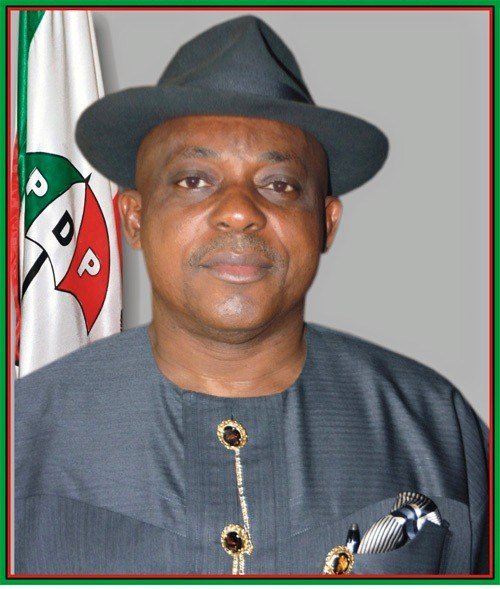
…says suit frivolous, not justiciable
The Court of Appeal in Abuja has set aside the orders by Justice Inyang Ekwo of the Federal High Court, Abuja barring three chieftains of the Peoples Democratic Party (PDP) from further attending any meeting of the PDP National Executive Committee (NEC) or participating in deliberations or proceedings of the meetings in any manner.
The PDP chieftains are the party’s former National Chairman, Prince Uche Secondus; sacked Rivers governor, Celestine Omehia, and a former Deputy Speaker of the House of Representatives, Austin Opara.
Three separate judgments were delivered on Friday, 16th of August 2024 by a three-member panel of the Court of Appeal, which unanimously upheld the appeals filed by Secondus, Omehia, and Opera for being meritorious.
The appellate court held that the issue of whether members of a party should attend the party’s meetings or participate in any of its activities is one that should be determined by the political party.
The court was of the view that issues relating to whether or not members of a political party attend the party’s meetings, being the internal affairs of the party, are not justiciable and on which the court lacked jurisdiction.
It held that the Federal High Court ought not to have entertained the cases because it lacked the jurisdiction to hear and determine the suits dealing with issues within the realm of the internal affairs of the political party.
The Court of Appeal proceeded to declare null and void the proceedings conducted in the three cases before the Federal High Court, voided same, including the restraining orders made ex-parte by Justice Ekwo on 5th April 2024.
This judgment brings to the fore the issues of justiciability of matters adjudged to be the internal affairs of political parties, which are usually entertained by corrupt judges to give reprieve to petitioners or plaintiffs who are desperate to secure an order to restrict, restrain, or bar their political opponents from participating in party activities to gain some fiduciary advantage in an anticipated matter or decision. It’s an issue worth examining.
This grundnorm was flagrantly violated by the Supreme Court in the case of Uche Secondus vs The Peoples Democratic Party (PDP) Rivers State chapter over the purported suspension of the latter by the ward and local government chapters and ratified by the state executive committee of the party. The suspension was later stamped with the seal of the authority of the high court of Rivers State Degema judicial division, presided over by Hon Justice Okagbule Gbasam, a vacation judge at the time of the ruling, who not only expressly gave an exparte order directing the erstwhile National Chairman of the party not to parade himself in his official capacity but proceeded, despite the intervention of the Chief Justice of the Federation Justice Ibrahim Tanko Muhammad CFR directing all parties to return to the status quo antebellum before the issuance of the conflicting court orders by the same courts of coordinate jurisdiction to further issue a perpetual injunction restraining the hitherto Chairman from performing the functions of his office.
Prince Secondus, who is armed with sufficient constitutional arguments as espoused in section 57 (7) of the PDP constitution which states interalia; “Notwithstanding any other provision relating to discipline, no executive committee at any level, except the National Executive Committee, shall entertain any question of discipline as may relate or concern a memember of the National Executive Committee, Deputy Governors, or members of the National Assembly, provided that nothing in this constitution shall preclude or invalidate any complaint submitted through the National Working Committee to the National Executive Committee concerning any person whatsoever”, to enable him to reverse such an abnormality but was prevented from doing so by the presiding judge of the high court and the appellate court. His desire to secure justice propelled him to head to the Supreme Court with his head held high. His lawyer Bar Tayo Oyetibo SAN has a record of being a diligent and meticulous prosecutor of cases.
While the PDP and its stalwarts were reported to have bragged about their judicial exploits of compromising the justices, Secondus was undaunted in his unwavering commitment to seeking justice.
The case as determined was perhaps viewed by pundits as a trial within a trial. It was considered a trial of the judiciary by the same organ, in the same token of an unlawful prescription of an exparte order to illegally remove a sitting elected party official before the expiration of his tenure.
The issues for determination are bothered by the procedure for the removal of an officer of the party and whether such procedures have been complied with. Whether the apex court had the resolve to set precedence by disallowing the use of the judiciary to perpetrate injustice thereby desecrating the sacred temple.
More succinctly juxtaposed is whether the decisions of the National Judicial Council (NJC) on the erring judges about the issuance of conflicting court orders by courts of coordinate jurisdiction on this subject matter and the disciplinary actions initiated by the Nigerian Bar Association on the erring lawyers, on the other hand, will have played any significant role in the determination and justiciability of the issues at hand.
As the bastion of hope for the common man, the Supreme Court went beyond the law to subvert the course of justice.
Had the Supreme Court granted the prayers of Secondus to complete his truncated tenure, it would have sent a strong signal to the polity that there is no shortcut to justice. It should be noted that to exercise such constitutional responsibility, the precinct of a political party should play such a role and not through courts or judicial orders that are beyond the authority and competence of the judicature.
