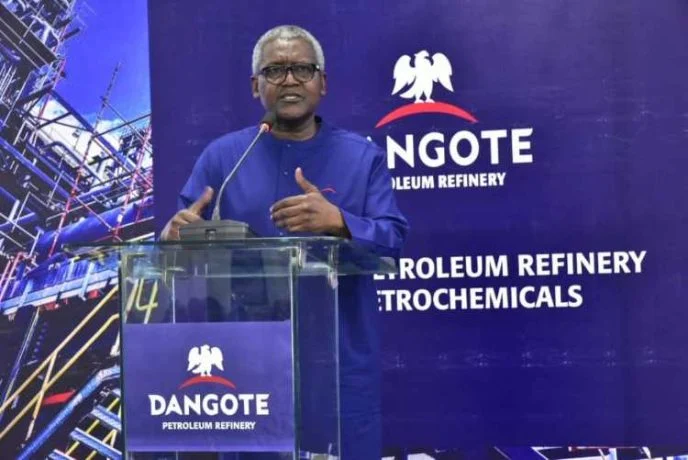
Nigeria may be on the verge of its most consequential capital market event in years as the Dangote Refinery prepares a public share offering that could value the facility at $40billion and raise as much as $5 billion from investors.
If completed, the listing would allow Nigerians and global investors, to own a direct stake in a refinery that is already reshaping West Africa’s energy landscape.
The refinery, located in Lagos and built by the Dangote Group, is one of the world’s largest single-train refineries, with capacity to process 650,000 barrels of crude oil per day.
It produces petrol, diesel, aviation fuel, and petrochemicals, and has already begun supplying a significant portion of Nigeria’s domestic fuel demand while exporting surplus products abroad.
The proposed listing is expected to float between 5% and 10% equity, making it one of the largest IPOs ever attempted on the continent.
The company has reportedly appointed Stanbic IBTC Capital Ltd., Vetiva Advisory Services Ltd. and FirstCap Ltd. as advisers for the proposed IPO.
What an IPO means
An IPO, or Initial Public Offering, is the first time a privately held company sells shares to the public. Once listed, investors can buy and trade those shares on a stock exchange—in this case, the Nigerian Exchange (NGX), subject to final approvals.
For many retail investors, this would be the first opportunity to gain exposure to a major industrial energy asset of this scale.
Why the offer is drawing attention
Market analysts say the size alone makes the transaction historic, potentially surpassing previous African listings by several multiples.
Another standout feature is the proposed dividend structure. Investors would buy shares in naira but receive dividends in US dollars—an arrangement designed to attract investors and potentially hedge against currency depreciation. However, this structure is still subject to regulatory approval.
Access and participation
If approved, investors will need a CSCS account (Central Securities Clearing System) to hold shares electronically. Participation typically requires a BVN, NIN, and a brokerage account through a licensed stockbroker or digital investment platform.
Risks remain despite scale
Despite strong interest, the IPO is not without risks. Key concerns include the refinery’s financing structure, global oil price volatility, regulatory approval for dividend arrangements, and uncertainty around final valuation and share allocation.
Only a small portion of equity is expected to be made available to the public.
A potential turning point for Nigeria’s capital market
If the listing proceeds, it could significantly deepen Nigeria’s stock market, expand retail investor participation, and introduce a new category of large-scale industrial assets to the exchange.
For now, the offering remains pending regulatory approvals and final prospectus release. But expectations are already high that it could become one of Africa’s defining capital market moments.
Key points
The IPO is valued at $40–50bn and a planned raise of up to $5 billion.
The listing would allow both Nigerian and global investors to buy shares in the refinery for the first time.
The IPO is expected to float 5%–10% equit.
Proposed US dollar–linked dividend structure
CSCS account, BVN, NIN, and a licensed stockbroker or investment platform is needed.
Key risks include oil price volatility, regulatory approvals, valuation uncertainty, and limited share availability.
(Daily Trust)