


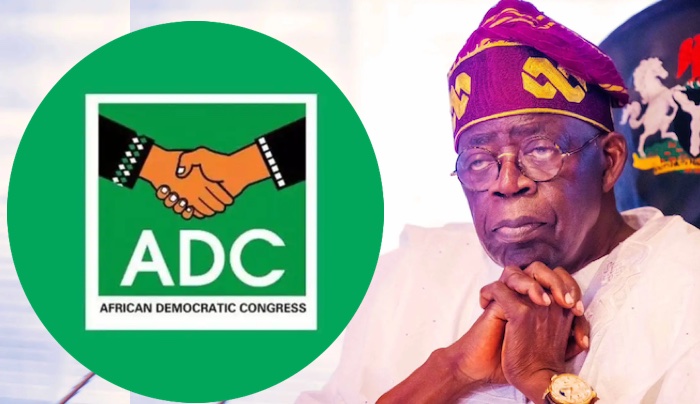
. His policies have ruined lives, says coalition party
. Tinubu’s govt one of the most reckless in history – Atiku

African Democratic Congress, on Saturday, advised President Bola Tinubu to “abandon his neoliberal economic policies that has ruined the lives of almost the entire country or simply quit,” saying Nigerians cannot continue on this same path, just as the ADC presidential candidate and former Vice President, Atiku Abubakar, declared that the shocking revelation of over ₦210 billion in overlapping and duplicated allocations in the 2026 Federal Budget, coming on the heels of Nigeria’s dismal performance on nearly 90 percent of globally recognised prosperity indicators, has exposed the Tinubu administration as one of the most fiscally reckless governments in Nigeria’s democratic history.
ADC, in a statement, on Saturday, said it is deeply concerned by recent reports by the World Bank indicating that 139 million Nigerians now live below the poverty line.
Atiku on his part, in a statement by his Senior Special Assistant on Public Communication, Phrank Shaibu, said the two independent reports have finally stripped away the propaganda surrounding the administration’s so-called economic reforms and revealed a painful truth: Nigeria is not failing because of a lack of resources, but because of a profound failure of leadership.
According to the ADC, the report is consistent with a similar report by the World Food Programme (WFP) “that 17 million Nigerians are now living with acute hunger, with the worst food security crisis the country has experienced in nearly a decade.”
The statement signed by the National Publicity Secretary of the ADC, Mallam Bolaji Abdullahi, stressed that these reports were “stark evidence that the present administration’s economic policies have failed and are likely to deliver even more catastrophic consequences if President Tinubu continues in office beyond 2027.”
The coalition party said the reports are not surprising as this “catastrophic situation is the inevitable consequence of economic policies that have favoured money over people and statistics over survival.”
The party said they have warned that the economic growth, increased revenue, and rising foreign reserves that the APC government continues to celebrate are meaningless if they do not translate into better lives for the people or protect their livelihoods.
“Instead of changing course, the government has stubbornly stuck with its ruinous economic policies and even continues to market recklessness as courage and wickedness as “necessary pains.”
ADC said three years down the line, it is now clear that the chicken has come home to roost.
“The evidence of 139 million people living in poverty and 17 million at the risk of starvation is President Tinubu’s scorecard. On account of this catastrophic failure alone, President Tinubu should be contemplating resigning from office rather than seeking re-election.
“What Nigeria desperately needs is a President and a government that truly understand how the people feel and genuinely care about them. A government that understands that the true measure of any economic policy is whether it improves the lives of the people, not compounds their misery.
“A President whose government is not openly feasting while asking the people to continue fasting. A government that does not wallow in profligacy while handing the people palliatives.
“This is why the ADC rejects the cycle of temporary interventions and emergency responses that has come to define the APC’s economic policies in the name of social intervention programmes. Poverty cannot be defeated through palliatives. It can only be defeated by building an economy that enables Nigerians to produce more food, earn decent incomes, and live with dignity.
“An ADC government will therefore pursue structural reforms that address the root causes of hunger”.
If voted into power, ADC said they would reduce energy cost and make food production safe again.
“We will secure farming communities and agricultural corridors so that farmers can return to their land without fear, cultivate throughout the farming season and transport their produce safely and affordably to markets. No nation can achieve food security while insecurity keeps farmers away from their farms.
“We will increase domestic food production. We will prioritise the rehabilitation of Nigeria’s 264 abandoned dams and bring them back to productive use, to expand year-round irrigation across farming communities. We will improve access to quality seeds, fertilisers and extension services, while investing in storage, preservation and agro-processing facilities that reduce post-harvest losses and increase the amount of food reaching Nigerian markets.”
The statement said the choice before Nigeria is no longer between competing economic theories.
“It is between an economy that produces impressive government statistics and one that produces better lives for its people. Hunger is the most honest measure of economic performance because it cannot be manipulated.”
On his part, Atiku described the Tinubu’s government as one of the most reckless in Nigeria’s history.
His statement partly read, “For more than three years, Nigerians have been subjected to relentless hardship. They were told that fuel subsidy removal, exchange rate unification, higher taxes and rising tariffs were bitter pills that would eventually restore economic stability. Yet today, the same government cannot explain how more than ₦210 billion found its way into duplicated and overlapping budget provisions.
“When a government asks its people to sacrifice, it must first demonstrate discipline. Instead, what Nigerians have seen is a budget riddled with duplication, questionable insertions, overlapping projects and expenditures that offend both common sense and fiscal responsibility.”
The ADC presidential candidate noted that this latest investigation did not emerge in isolation but adds to a growing catalogue of troubling budget practices that have repeatedly raised serious questions about the integrity of public finance.
“In recent months, Nigerians have witnessed budgetary allocations for projects outside the statutory mandates of agencies, controversial insertions running into billions of naira, and expenditures that bear little relationship to the pressing needs of ordinary citizens. Rather than responding with transparency, the government has too often resorted to denial before reluctantly acknowledging problems when confronted with overwhelming evidence.
“Nothing illustrates the bankruptcy of this administration’s so-called reforms more than the fuel subsidy deception. Nigerians were told in 2023 that subsidy was gone and were compelled to endure unprecedented hardship—skyrocketing fuel prices, crushing transportation costs, runaway inflation and a collapsing standard of living—in the name of economic reform. Yet NNPC Limited’s own audited 2024 financial statements now reveal that a staggering ₦7.13 trillion was still expended on what it calls ‘Energy Security Expenses,’ a category the company itself identifies as petrol subsidy, otherwise known as under-recovery. This means Nigerians were never told the whole truth. The subsidy was not eliminated; it was merely repackaged, renamed and quietly charged against the Federation. A government that conceals ₦7.13 trillion behind a convenient euphemism while demanding sacrifice from millions of struggling citizens cannot claim the moral authority to preach reform, prudence or fiscal discipline. Nigerians deserve to know who authorised this expenditure, who benefited from it, and why the administration chose to market deception as economic reform.”
He said this pattern demonstrates that the problem is no longer isolated errors but a systemic breakdown in budget discipline.
“The national budget is the single most important economic policy document of any government. It should reflect national priorities, inspire investor confidence and assure citizens that every naira borrowed or earned will be spent wisely. When that document itself becomes contaminated by duplication and overlapping allocations, confidence in the entire machinery of government is undermined.”
The former Vice President said the consequences of this fiscal indiscipline are evident in the country’s declining prosperity rankings.
“While government officials celebrate selective macroeconomic indicators, Nigerians are experiencing a different economy entirely. Families are skipping meals. Parents are struggling to pay school fees. Small businesses are shutting their doors. Manufacturers continue to battle soaring production costs. Young graduates cannot find jobs. Farmers are trapped between insecurity and inflation.
“It therefore comes as no surprise that Nigeria is now lagging behind its peers across almost every meaningful indicator of prosperity. A nation cannot budget for waste and expect prosperity. It cannot institutionalise inefficiency and hope for development.”
Atiku said the contradiction at the heart of the Tinubu administration has become impossible to ignore.
“On one hand, government claims reforms are succeeding. On the other hand, it continues to borrow aggressively despite periods of stronger oil prices, while revelations of duplicated allocations raise legitimate questions about how public resources are being managed. The tragedy is not merely that Nigeria is borrowing; it is that Nigerians are increasingly uncertain whether those borrowings are producing commensurate value.”
He stressed that genuine reform requires government to subject itself to the same discipline it demands from citizens.
