



Adesegun Osibanjo
From Central Grid Failure to Distributed Power Markets

Nigeria’s Electricity transition is no longer about fixing a broken grid—it is about redesigning the architecture of power itself.
Since the 2013 privatisation, the sector has operated under a structurally conflicted model: privately held generation assets, fragmented distribution across concessionaires, and a centrally controlled regulatory framework. The result is a system that appears capable on paper but consistently fails in delivery.
Installed capacity exceeds 13,000 MW, yet actual delivered power has rarely sustained 5,000 MW.
That gap is not technical. It is structural.
The Structural Constraint: A System Designed Not to Deliver
Nigeria’s Electricity challenge is frequently framed as a Generation deficit. That diagnosis is incomplete. The real issue is a breakdown in coordination across the value chain, reinforced by centralised control and fragmented accountability.
The constraints are interconnected.
Gas supply instability continues to undermine thermal generation, the backbone of the system, with pricing disputes, infrastructure gaps, and payment risks limiting reliable dispatch.
Transmission imposes a binding ceiling. The national grid has rarely wheeled more than approximately 5,800 MW, meaning that even available generation cannot be evacuated at scale.
Distribution compounds the failure. High technical and commercial losses, weak metering penetration, and poor revenue recovery ensure that electricity delivered is not fully monetised. This has escalated into a sector liquidity crisis measured in trillions of naira, weakening every segment of the market.
These are not isolated inefficiencies. They reflect a system in which no single actor has both the authority and incentive to resolve end-to-end performance.
Chart 1: Installed Capacity vs Delivered Power (2013–Present)
The chart compares installed Generation capacity and actual delivered power from 2013 to the present. Installed capacity rises steadily from approximately 10,000 MW to over 13,000 MW. Delivered power, by contrast, remains volatile and constrained, fluctuating between roughly 3,500 MW and 5,800 MW.
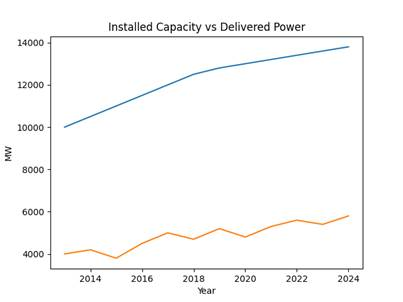
The widening divergence between the two lines reveals the core structural dysfunction of the sector. Capacity expansion has not translated into reliable supply, demonstrating that the binding constraint is not infrastructure availability but system inefficiency in converting capacity into delivered electricity.
Electricity Act 2023: From Central Control to Market Fragmentation
The Electricity Act fundamentally reconfigures this structure by transferring regulatory authority to subnational governments. States can now establish electricity markets, license operators, and procure power within their jurisdictions.
More than twenty states have already begun operationalising these powers.
This marks a decisive shift from a single national electricity system to multiple emerging power markets shaped by local demand conditions, regulatory capability, and investment readiness.
Chart 2: Evolution of Electricity Market Control in Nigeria
The chart compares regulatory control before and after the Electricity Act. In the pre-Act structure, Federal authority dominates almost entirely, with negligible State participation. In the post-Act structure, Federal control declines while State-level regulatory authority increases significantly, reflecting the emergence of decentralised Electricity governance.
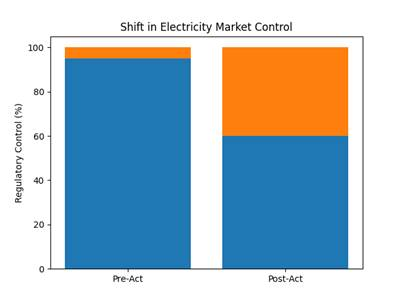
This shift represents more than administrative reform. It signals a redistribution of economic control, where investment decisions, market design, and execution increasingly shift closer to subnational actors.
Why Decentralisation Changes the Economics of Power
Centralisation did not fail due to lack of intent. It failed because it attempted to manage a highly uneven and geographically diverse demand landscape within a rigid, uniform market structure that could not respond effectively to local realities.
Decentralisation introduces a different logic. It aligns supply, demand, and accountability within the same geographic and institutional space, allowing decisions to be made closer to consumption and value creation.
States can now design power systems tailored to their economic structures, including dedicated solutions for industrial clusters, embedded generation linked directly to commercial demand centres, and clearly defined sub-markets capable of attracting targeted private capital. It also reduces reliance on a national grid constrained by persistent transmission and liquidity bottlenecks.
This is not administrative adjustment. It is a shift in market architecture. Electricity moves from being centrally rationed to locally optimised.
Early State Signals: Execution Over Rhetoric
State-level engagement is pragmatic rather than ideological, focused on institutional development, regulatory design, and project structuring.
Early efforts are concentrated on independent regulatory commissions that provide credibility and stability, embedded generation frameworks that link supply directly to demand nodes, and public–private partnerships designed to mobilise capital and technical expertise. Increasing attention is also being directed toward industrial and urban demand centres, where power access delivers immediate economic returns.
The direction of travel is clear. Electricity is being repositioned from a passive public utility into a direct driver of economic productivity, industrial activity, and investment attraction.
Investment Implications: From Systemic Risk to Defined Markets
For investors, this shift fundamentally changes how the sector is evaluated and financed.
A centralised system aggregates risk into a single national profile characterised by regulatory opacity, infrastructure constraints, and systemic inefficiencies. A decentralised system disaggregates that risk into multiple, smaller, and more transparent investment environments.
Each State becomes a distinct market with its own regulatory structure, demand profile, and execution capacity.
Capital allocation becomes more precise. Investment can now flow into State-backed Generation with defined off-take arrangements, Industrial cluster energy solutions anchored in concentrated demand, embedded generation with predictable revenue structures, and modular mini-grid or hybrid systems with faster deployment cycles.
This reduces one of the most persistent barriers to investment in Nigeria’s power sector: the combination of regulatory uncertainty and systemic opacity. By breaking the system into governable units, risk becomes more legible and more accurately priced.
Chart 3: Projected Investment Flow into State Electricity Markets
The chart presents projected capital allocation across four segments: Grid-scale generation, embedded generation, distribution infrastructure, and mini-grid or off-grid systems. While Grid-scale generation continues to attract investment, growth is slower relative to decentralised solutions. Embedded generation and mini-grids show the strongest upward trajectory, reflecting a shift toward modular, demand-linked infrastructure.
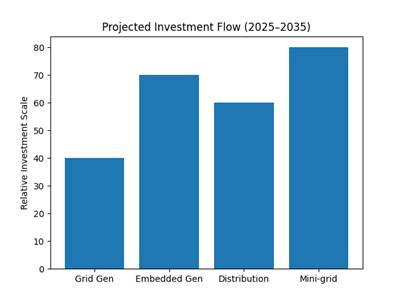
The pattern reflects a structural change in investor behaviour. Capital is increasingly favouring smaller, scalable, and demand-anchored systems with clearer revenue visibility. Bankability is becoming more important than scale.
The Risks: Decentralisation Is Not a Shortcut
Decentralisation introduces opportunity, but it does not eliminate structural risk.
State regulatory capacity remains uneven, raising the possibility of fragmented inefficiencies across jurisdictions. Tariff setting remains politically sensitive, with cost-reflective pricing still contested in many regions. Gas supply constraints persist as an upstream limitation that decentralisation does not resolve. Without coordination, fragmentation could also weaken system stability and introduce regulatory inconsistency that deters investment.
The Federal Role: From Operator to System Architect
The Federal government’s role is not diminished but redefined.
Its focus shifts to maintaining transmission infrastructure as the national backbone of the system, stabilising market operations to prevent fragmentation from becoming disorder, and ensuring policy coherence across emerging state markets.
It also plays a critical role in enabling interoperability between decentralised systems, ensuring that infrastructure planning, power flows, and market design remain technically and economically aligned.
In this structure, the centre no longer operates the system. It stabilises it.
Conclusion: Reform Has Given Way to Redesign
Nigeria’s Electricity sector has moved beyond incremental reform into structural redesign.
The emergence of State-level regulatory authority marks a shift toward a system where Eelectricity is generated closer to demand, governed closer to accountability, and financed with clearer risk visibility.
If executed effectively, this transition can improve reliability, unlock investment, and support industrial expansion.
If mismanaged, it risks reproducing existing inefficiencies across multiple fragmented systems.
Decentralisation is not the solution. It is the opening.
What follows will determine whether this becomes a structural turning point or another cycle of unrealised reform.
This Article launches the Thematic series “States Gaining Electricity Regulatory Powers in Nigeria,” examining the transition from a centralised Electricity system to decentralised, State-driven Power markets and its implications for Investment and Economic growth.
. Adesegun Olutayo Adeolu Osibanjo, BEng, MBA, is an Energy & Climate Strategist and Policy & Systems Transformation Architect, and a COREN-Registered Engineer in the Federal Republic of Nigeria.
