


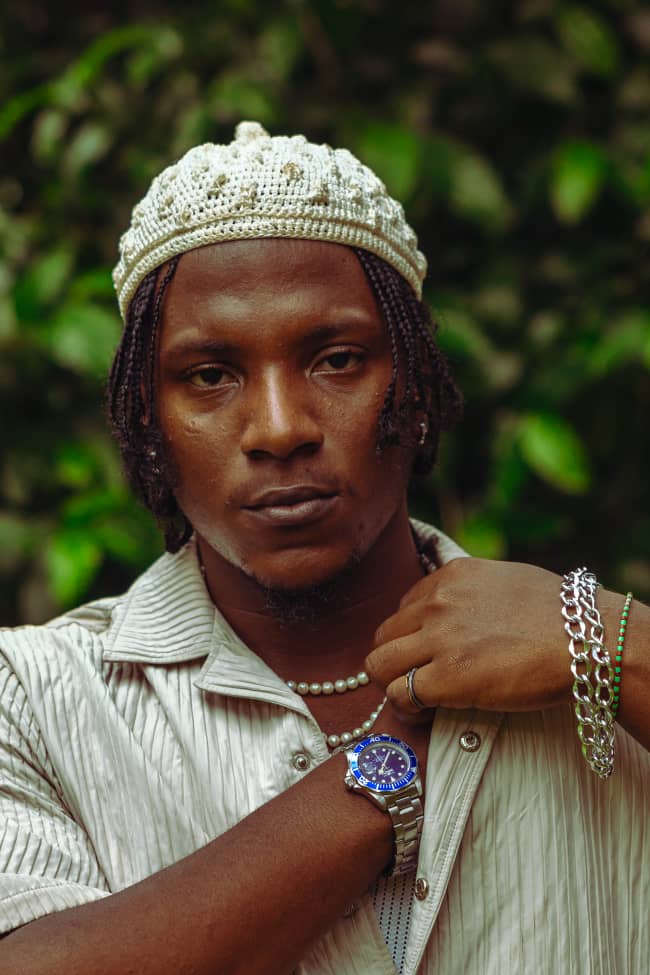
At the intersection of music, ancient wisdom, and cultural reclamation, a Nigerian-born Afrofusion artist is carving out a bold new cultural movement. Known as Soga or ADESOGA, the artist, cultural curator and spiritual instructor is spearheading what he calls the Orí Renaissance—a growing effort to modernise, preserve and reintroduce Yoruba spiritual philosophy to a global audience.
Rooted in the concept of Orí—a Yoruba term referring to one’s inner spiritual essence, intuition and destiny —the movement places personal consciousness at the centre of identity and liberation. For Adesoga, this idea challenges widespread misconceptions about African spirituality, which he argues has often been misrepresented or reduced to stereotypes.

“At the foundation of our tradition is the self,” he explains through his work. “Before any external force, there is Orí.”
Adesoga’s approach is not abstract. A fluent Yoruba speaker with deep cultural grounding, he draws from a lineage steeped in traditional knowledge. He is the son of Araba Olatunji Somorin and Oluwakemi Somorin, founders of the Ketus Institute, which operates across the United States, Canada, and Trinidad and Tobago. His mother, a longtime Yoruba language instructor at the University of the West Indies, has played a key role in building the academic and cultural framework that supports this revival.
In March 2026, Adesoga expanded the reach of his work as creative director for cultural showcases at the University of the West Indies open house events. There, Nigerian artifacts, traditional textiles, and ancestral attire were presented to highlight their historical and contemporary relevance. One standout exhibition explored the Egungun masquerade tradition—an enduring Yoruba cultural practice—and traced its influence on Caribbean Carnival and diaspora traditions.
Beyond exhibitions, Adesoga’s programming draws international participation. Attendees from the United States, the United Kingdom, and Canada have engaged with workshops on ancestral herbs, plant medicine, and traditional systems of knowledge, including divination practices.
Music remains his primary medium. Blending Afrofusion sounds with philosophical storytelling, Adesoga uses his platform to communicate complex cultural ideas in accessible ways. His work has begun attracting attention beyond traditional circles, with engagement from global artists, including American R&B singer SZA and Nigerian artist, Boy Spyce of Mavin Records.
A defining symbol of his identity is the distinctive headpiece he wears—a sacred item tied to his lineage and given by senior members of his family. Representing Orí, it signifies both spiritual authority and responsibility. For Adesoga, it also embodies his role as a bridge between continents, reconnecting members of the African diaspora to ancestral roots disrupted by slavery and colonisation.
Despite its spiritual focus, the Orí Renaissance is not positioned as a rejection of religion. Instead, it advocates for deeper understanding. Adesoga emphasises that Yoruba spirituality has often been misunderstood—even by its practitioners—through the lens of colonial and external interpretations. His work seeks to reframe that narrative, centring self-awareness as the foundation of spiritual practice.
Looking ahead, Adesoga aspires to be recognised as a “Babalawo singer”—an artist-sage who merges traditional wisdom with contemporary music to reach a global audience.
As conversations around African identity and cultural heritage gain momentum worldwide, the Orí Renaissance is steadily taking shape. And through music, education, and cultural storytelling, Adesoga is ensuring that it is both preserved and reimagined for a new generation.
