


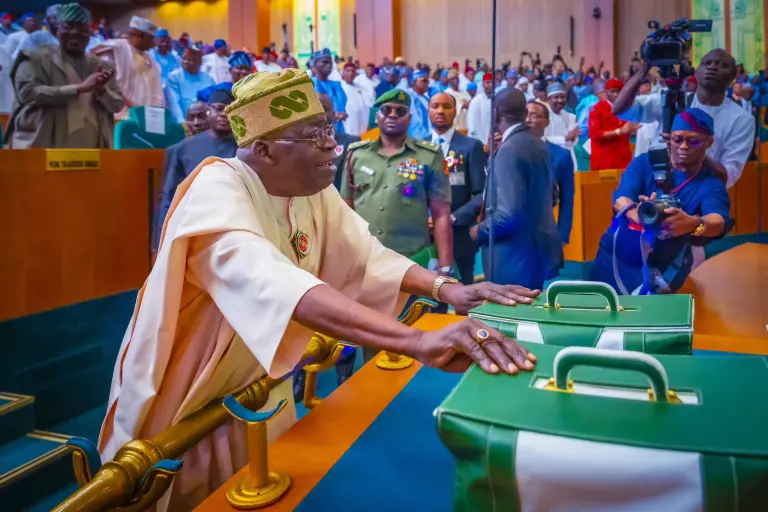
President Bola Tinubu, on Friday, presented the N58.18 trillion 2026 Appropriation Bill to the National Assembly, projecting debt servicing to gulp N15.52 trillion.
The N15.52 trillion set aside for debt servicing represents about 26.7 per cent of the total expenditure, exceeding allocations to several key sectors and remaining one of the largest single spending items in the budget.

Tinubu while presenting the budget christened: “Budget of Consolidation, Renewed Resilience and Shared Prosperity” to a joint session of the Senate and House of Representatives, said the proposed spending framework reflects the administration’s determination to consolidate macroeconomic reforms while managing debt with discipline.
The President disclosed that total projected expenditure for 2026 stands at N58.18 trillion, against expected revenue of N34.33 trillion, leaving a deficit of N23.85 trillion, equivalent to 4.28 per cent of Gross Domestic Product (GDP).
Other major components of the budget include N15.25 trillion for recurrent (non-debt) expenditure and N26.08 trillion for capital spending, reflecting the government’s stated emphasis on infrastructure, human capital and productivity.
He acknowledged the fiscal pressure imposed by debt obligations but assured that his administration remains committed to fiscal sustainability, transparency and value-for-money spending.
Tinubu argued that despite the rising cost of servicing debt, recent reforms are beginning to yield results, citing 3.98 per cent GDP growth in Q3 2025, moderation in inflation to 14.45 per cent in November 2025, improved oil output and an increase in external reserves to about $47 billion, a seven-year high.
Under the budget proposal, security received the lion’s share of N5.41 trillion, underscoring emphasis on addressing security challenges in the country.
If approved, defence and security would have cumulatively gulped N19.91 trillion in the last six years.
A sectoral breakdown of the proposal showed that infrastructure followed security with an allocation of N3.56 trillion, while education received N3.52 trillion and health was allocated N2.48 trillion.
Besides the N5.41 trillion 2026 allocation for the defence sector, records indicate that over N14.5 trillion has been allocated to the security sector in the past five years as part of sustained efforts to strengthen national security.
Since 2021, budgetary provisions for defence, the police and other security agencies have risen steadily. In 2023, defence and security received N2.74 trillion, representing 13 per cent of total expenditure.
The allocation stood at N2.41 trillion in 2022, while the 2021 budget provided N840.56 billion, alongside N121 billion for capital projects. In 2024, security again took the largest share with N3.25 trillion, about 12 per cent of the total budget.
Despite the rising allocations, the country continues to grapple with terrorism, insurgency, banditry and kidnapping, prompting concerns among stakeholders about the effectiveness of the huge spending in delivering tangible security outcomes.
The presentation of the 2026 budget followed the passage of the 2026–2028 Medium-Term Expenditure Framework (MTEF) and Fiscal Strategy Paper (FSP) by the National Assembly earlier this week.
Although lawmakers initially approved a budget estimate of N54.5 trillion, the Federal Executive Council later approved an upward review to N58.18 trillion. The approval was granted at an emergency meeting of the Federal Executive Council chaired by Vice President Shettima.
Briefing newsmen afterwards, the Director-General of the Budget Office, Tanimu Yakubu, said the 2026 budget was six per cent higher than the 2025 estimate.
Addressing lawmakers, President Tinubu said the 2026 budget was designed to consolidate ongoing reforms, stabilise the economy and translate recovery into improved living standards for Nigerians.
He noted signs of economic stabilisation, including improved growth, moderating inflation, rising oil production and stronger external reserves.
The President stressed that the budget prioritises security, human capital development and infrastructure as interlinked pillars for national renewal, stressing that without security, investment cannot thrive, and without educated and healthy citizens, productivity will remain weak.
According to President Tinubu, expected total revenue is N34.33 trillion, projected total expenditure N58.18 trillion, including N15.52 trillion for debt servicing and recurrent (non‑debt) expenditure: N15.25 trillion.
Others are capital expenditure, N26.08 trillion, budget deficit and N23.85 trillion, representing 4.28% of GDP.
He added, “These numbers are not just accounting lines. They are a statement of national priorities. We remain firmly committed to fiscal sustainability, debt transparency, and value‑for‑money spending.
“The 2026–2028 Medium‑Term Expenditure Framework and Fiscal Strategy Paper sets the parameters for this Budget. Our projections are based on a conservative crude oil benchmark of US$64.85 per barrel; crude oil production of 1.84 million barrels per day; and an exchange rate of N1,400 to the US Dollar for the 2026 fiscal year.”
He said the 2026 budget will be marked by stricter discipline in budget implementation, with a strong focus on accountability, efficiency and timely execution.
According to him, clear directives have been issued to the Minister of Finance and Coordinating Minister of the Economy, the Minister of Budget and Economic Planning, the Accountant-General of the Federation and the Director-General of the Budget Office to ensure that the 2026 budget is implemented strictly in line with approved provisions and timelines.
The President expressed optimism that revenue performance would improve significantly, driven by the new National Tax Acts and ongoing reforms in the oil and gas sector.
He noted that the reforms are aimed not only at increasing revenue, but also at promoting transparency, efficiency, fairness and long-term value within the nation’s fiscal framework.
Tinubu also issued a firm warning to Government-Owned Enterprises (GOEs), directing their heads to meet assigned revenue targets. To achieve this, he said the government would deploy end-to-end digitisation of revenue mobilisation, including standardised electronic collections, interoperable payment systems, automated reconciliation, data-driven risk profiling and real-time performance dashboards.
He stressed that these measures would help eliminate leakages, ensure verifiable compliance and guarantee prompt remittances. The President added that revenue targets would form key components of performance evaluations and institutional scorecards, warning that Nigeria can no longer tolerate inefficiencies, leakages or underperformance in strategic agencies.
Tinubu said his administration’s reform efforts were already yielding measurable results.
He added, “Our economy grew by 3.98% in Q3 2025, higher than the 3.86% recorded in Q3 2024. Inflation has moderated for eight consecutive months, with headline inflation declining to 14.45% in November 2025, from 24.23% in March 2025. With stabilising food and energy prices, tighter monetary conditions, and improving supply responses, we expect the disinflationary trend to persist—so that inflation continues to decline further over the 2026 horizon, barring major supply shocks.
“Oil production has improved, supported by enhanced security, technology deployment, and sector reforms. Non‑oil revenues have expanded significantly through better tax administration —not excessive taxation.
“Investor confidence is returning, reflected in capital inflows, renewed project financing, and stronger private‑sector participation. Our external reserves rose to a 7‑year high of about US$47 billion as at 14 November 2025, providing more than 10 months of import cover and a stronger buffer against shocks.”
President Tinubu also announced that the era of multiple budget implementations in Nigeria will come to an end by March 2026, stating that from April, the country will operate a single budget anchored on a unified revenue cycle.
According to the President, the reform is aimed at addressing long-standing challenges such as abandoned projects, unpaid contractual obligations and overlapping budgets inherited across different administrations.
“This is research, a very hard one. Avoiding abandoned projects, unpaid contractual obligations and running multiple budgets, both inherited and of fulfilled mandates, is a problem staring the nation.
“So we are terminating the habit of running through a budget on one inflow. By March 31, 2026, all capital liabilities from previous years will be fully funded and closed. No overlaps, no excuses and no rollover cultures,” he said.
Meanwhile, President Tinubu has asked the National Assembly to repeal and re-enact the 2024 and 2025 Appropriation Acts, while also seeking an extension of the 2025 budget implementation to March 31, 2026.
The request was contained in a letter dated December 18, 2025, addressed to the Speaker of the House of Representatives, Abbas Tajudeen, and read on the floor of the House on Friday.
In the letter, President Tinubu transmitted the Appropriation (Repeal and Re-Enactment) Bills, 2024 and 2025, for legislative consideration in line with constitutional and appropriation procedures.
According to the President, the 2024 Appropriation Act of N35.06 trillion is to be repealed and re-enacted at N43.56 trillion. The revised figure comprises N1.74 trillion for statutory transfers, N8.27 trillion for debt service, N11.27 trillion for recurrent (non-debt) expenditure, and N22.28 trillion for capital expenditure and development fund contributions for the year ending December 31, 2025.
Similarly, the President proposed the repeal of the 2025 Appropriation Act of N54.99 trillion and its re-enactment at N48.32 trillion.
Tinubu said the reworked 2025 budget consists of N3.65 trillion for statutory transfers, N14.32 trillion for debt service, N13.59 trillion for recurrent (non-debt) expenditure, and N16.71 trillion for capital expenditure and development fund contributions.
The re-enacted 2025 budget is expected to run until March 31, 2026, instead of December 31, 2025.
President Tinubu explained that the proposed repeal and re-enactment were intended to accommodate budget items not previously recognised and to reflect a revised capital implementation target of 30 per cent.
He said the adjustment aligns with current fiscal realities and execution capacity, while ensuring credible and transparent budget performance. According to him, the extension of the 2025 budget would allow for the full release of the targeted 30 per cent capital funds across all ministries, departments and agencies (MDAs).
The President noted that the move forms part of broader fiscal reforms aimed at eliminating the overlap of multiple concurrently running budgets, improving planning, strengthening execution and enhancing accountability in public expenditure.
He added that the bills also seek to reinforce implementation discipline by ensuring that appropriated funds are released strictly for their approved purposes, limiting virement to cases approved by the National Assembly, and setting conditions for corrigenda where genuine errors may affect implementation.
Other provisions include separate recording of excess revenue, restricting its expenditure to legislative approval, mandatory compliance with due process, and periodic reporting on fund releases and agency-generated revenues.
Tinubu informed the House that the submission supersedes an earlier letter transmitted to the House, dated December 16, 2025, and urged lawmakers to consider and pass the bills expeditiously.
