


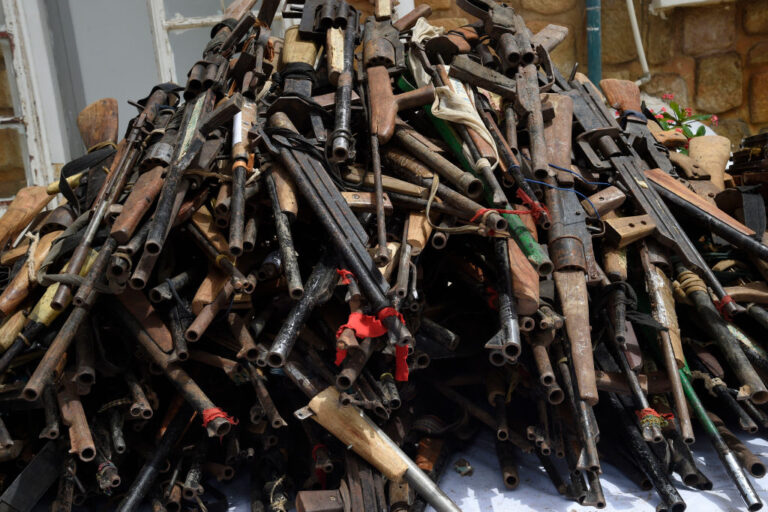
…claims 14,400 Nigerians killed in 19 months
Transparency International, on Thursday, raised the alarm that the Nigerian government squandered over $15 billion through fraudulent arms procurement deals in the last 20 years.
Head of TI in Nigeria and the Executive Director, Civil Society Legislative Advocacy Centre (CISLAC), Auwal Musa Rafsanjani, revealed this at its North West press conference for the dissemination of a policy brief titled ‘Nigeria’s Defence Sector: Persistent Corruption Risk Amidst Escalating Security Threats’, published by TI.
The policy brief highlighted findings from the 2020 Government Defence Integrity Index (GDI) that are pertinent for a path to enhanced institutional resilience to corruption in Nigeria’s defence governance.
The TI boss said the report was based on a close reading of the GDI results for Nigeria, policy literature, recent news reports, and context and problem analyses conducted by the CISLAC and TI in Nigeria.
The organisation also said data showed that external auditing of defence institutions was compromised by a lack of access to information and cooperation by the Ministry of Defence “which regularly refuses to submit documents in a timely fashion and bars auditors’ access to accounts.”
The Defence Headquarters, Ministry of Defence and the Nigeria Police Force have yet to react to the TI allegations as of the time of filing this report.
‘14,400 Nigerians killed in 19 months’
TI also alleged that no fewer than 14,400 Nigerians lost their lives to different forms of insecurity in the last 19 months in the country.
The organisation said the report underscores the decades-long struggle with systemic corruption in the security sector which places the country at 140th place out of 180 countries in the 2024 Corruption Perception Index (CPI).
Rafsanjani said, “Much of the concern over corruption in the Nigerian armed forces stems from its sizable but highly opaque military expenditure. From 2016 to 2022, Nigeria spent a total of over US$19.9 billion on security alone.
“The military budget was increased from US$2.4 billion in 2020 to a massive US$4.5 billion in 2021, slightly decreasing to US$3.2 billion in 2023. Despite the little increase in military success on the front line, Nigeria is the largest arms importer in sub-Saharan Africa, representing 16% of regional imports between 2019 and 2023.
“In its 2022 investigation, the Centre for Democracy and Development (CDD) revealed that about US$15 billion has been squandered through fraudulent arms procurement deals in the last 20 years. It also notes that these and other dealings of Nigeria’s defence and security institutions are shrouded in secrecy.
“Additionally, sexual forms of corruption (mostly involving women and girls) have increased. In terms of human security, violence continues with total fatalities for the last 19 months amounting to approximately 14,400.”
The head of TI further said Nigeria, as Africa’s most populous country, faced diverse corruption-induced security and financial issues.
“The ongoing corruption, fraud, financial mismanagement, and wider abuse of power within the defence and security sector have exacerbated Nigeria’s numerous security threats and threatened the country’s ability to mitigate escalating violent conflict within its borders. The failure of state security forces to protect local populations from terrorist violence has contributed to the proliferation of self-defence militias and the militarisation of local communities,” he stated.
According to him, human rights violations by state security forces compounded the problem, with recent concerns over the increasing use of air strikes that had resulted in numerous civilian deaths, using technology and arms supplied by global powers.
He stated, “Nigerian military and security forces have also been implicated in violence against civilians, including sexual and gender-based violence. This has been particularly pernicious in north-eastern Nigeria in counter-terrorism operations, where military and security personnel have allegedly been involved in sexual forms of corruption linked to survival sex (mostly involving displaced women and girls), sex trafficking and conflict-related sexual violence against women and girls as well as men and boys.
“Measures have been taken to hold security forces accountable for human rights violations, particularly through the Presidential Investigation Panel established in 2017. However, these measures did not yield the desired results, and impunity continues to be an ongoing problem among the armed forces.”
The TI boss further alleged that the country’s defence and security sector was plagued with systemic corruption which he identified as the major hindrance to the effective provision of defence in a country facing serious security challenges.
Rafsansaji also said the number of Nigeria’s armed forces personnel was below the recommended international standard of six personnel to 1,000 people, making it difficult for them to manage internal conflicts and domestic protests.
He added, “As of 2023, Nigeria had around 135,000 active-duty armed forces. However, the ratio of military personnel to population is approximately 1.1 per 1,000 people, far lower than the NATO average of 6 per 1,000 people or more than 20 military personnel per 1,000 people in countries facing conflicts, such as Eritrea, Israel, and Syria.
“This places Nigeria’s armed forces in a difficult position, as they face numerous security threats. The military is currently deployed on multiple fronts, fighting the Boko Haram terrorist activities in the northeastern corridors of the country, combatting banditry in north-west Nigeria, responding to communal crises in the Middle Belt and other hotspots around the country, and preventing piracy and oil theft in the Niger Delta area and the Gulf of Guinea.
“Human rights violations by state security forces compound the problem, with recent concerns over the increasing use of air strikes that have resulted in numerous civilian deaths, using technology and arms supplied by global powers. Nigerian military and security forces have also been implicated in violence against civilians, including sexual and gender-based violence.”
Rafsanjani also claimed that the existing legal provisions in the Nigerian Audit Act were outdated, thus rendering the Office of the Auditor-General for the Federation “operationally incapable of scrutinising the financial management of the sector.”
TI noted that to address the problems, the country’s defence institutions should prioritise transparency and access to information with a focus on defence budgets and disaggregated expenditures.
The international NGO added, “We demand adoption of global principles and standards for public disclosure of critical information about the defence sector, including defence budgets, competitive contracting, defence income and foreign assistance, disaggregated expenditures, and asset disposals.
“We demand establishing guidelines for separating confidential from non-confidential information, similar to the Global Principles on National Security and the Right to Information – The Tshwane Principles would help limit abuses by setting out what information on budgets and procurements could be disclosed. For genuinely confidential procurements, a separate legal procedure could be designed allowing for monitoring by a confidential senate committee and a unit with suitable security clearance within the Bureau for Public Procurement (BPP).
“Adequate monitoring mechanisms for gender-related compliance in the Defence and Security sector. This will help to prevent gender-based violence and abuse during operations. It has become imperative to fully implement the United Nations Security Council Resolution 1325 to adequately integrate women’s participation and representation at all levels of decision making in the defence and security sector.”
