


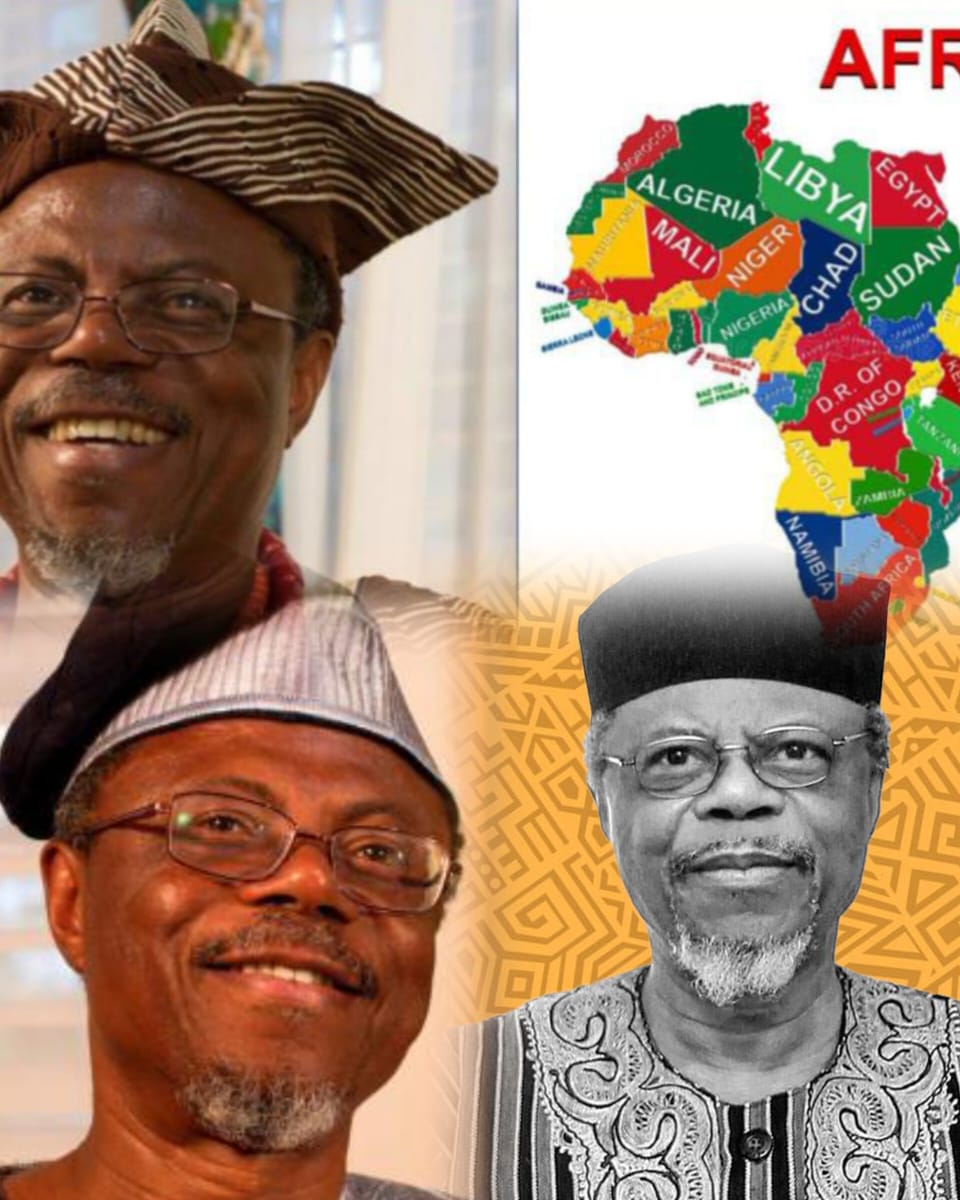
Eminent historian, author and internationally acclaimed scholar, Prof Toyin Falola will on Sunday September 13, 2026 take Africa’s development paradox to the intellectual hot seat as he features on the popular monthly interview discourse, Boiling Point Arena.
What comes under intense interrogation this time around is the issue of whether Africa can finally summon the political will, intellectual courage and collective determination to break free from the cycle of underdevelopment that has continued to frustrate its enormous promise.

The conversation, aptly framed around the theme, “The Africa We Want: Can the Continent Break Free from the Cycle of Underdevelopment?”, promises to be a penetrating examination of Africa’s development journey — where the continent has been, where it is today and, most importantly, where it must go from here.
Prof Falola is expected to take participants and audiences through what is expected to be a far-reaching examination of the historical forces, political choices and developmental contradictions that have shaped the African experience.
Boiling Point Arena, the once-in-a-month current affairs programme, is hosted by a seasoned media professional and communication strategy expert, Ayo Arowojolu.
To be transmitted via Zoom, the discourse, over a two-hour duration starting from 8pm, will be broadcast live on seven partner radio stations across Lagos, Ogun and Delta States.
Frontline traditional ruler, the Olowu of Owu Kingdom, Oba Prof. Saka Matemilola is the Chairman and Keynote speaker to herald the discourse.
Among the partner radio stations are; WASH 94.9FM, Lagos, Sweet 107.1FM, Abeokuta, Roots 97.1FM, Abeokuta, Erimbe 94.7FM, Shagamu, Women Radio 91.7FM, Mowe, Opera Tune 106.3FM, Abeokuta, and Kruzz 92.9FM, Asaba, Delta State alongside a cable television station, NSTV, on GOtv Channel.
The central question during the discourse will dovetail into this: How can the people of Africa navigate their way out of underdevelopment and begin to build the continent they have always imagined?
That question is expected to provide the intellectual fulcrum of the September edition as Prof Falola brings his formidable historical scholarship and deep understanding of African civilisation, politics, culture and development to bear on one of the continent’s most enduring challenges.
For generations, Africa has been described as a continent of immense promise, with vast natural resources, an extraordinary cultural heritage, enormous human capital, a youthful population and some of the world’s most significant deposits of strategic minerals and agricultural resources.
Yet, the paradox remains striking. A continent so richly endowed continues to battle poverty, unemployment, inadequate infrastructure, insecurity, weak institutions, poor governance, economic dependency and the persistent inability of many of its countries to translate natural wealth into broad-based prosperity.
To chart the way forward, the discourse will take introspective views from three major major flanks. Is Africa’s predicament primarily the consequence of its troubled history and the enduring consequences of colonialism?
Or have African societies and political elites themselves become complicit in reproducing the conditions that keep the continent underdeveloped?
Can Africa continue to blame external forces for problems that are increasingly rooted in internal governance failures?
This particular 47th edition of Boiling Point Arena, in attempting to solve the posers, will in addition explore what Africans themselves must do differently?
Prof Falola who is based in Austin, Texas, USA, will expectedly challenge participants to think about how Africa can become prosperous, self-reliant, innovative and globally competitive.
Also to be brought to the fore are the choices that must be made — politically, economically, educationally, technologically and culturally — if the continent is to escape the recurring pattern of dependency and underdevelopment.
At the centre of the forthcoming discourse is the question of leadership. For decades, the quality of political leadership across much of Africa has been one of the most contentious issues in the continent’s development debate.
While some African countries have recorded significant progress, many others continue to suffer from political instability, corruption, weak institutions and governance systems that have failed to create the conditions necessary for sustained development.
Indeed, the issues at stake are legion; Can Africa develop without fundamentally rethinking the nature of political leadership? Can democratic elections alone produce the transformational leadership the continent requires?
And should Africa begin to redefine leadership not merely as the occupation of political office but as the capacity to mobilise society towards a shared developmental purpose? To be sure, the place of institutions will equally be central to the debate.
The question, therefore, is whether Africa’s political systems are capable of producing such institutions — and what must be done to strengthen them.
Another major area likely to attract attention is education.
For Prof Falola, whose scholarly career has been deeply invested in African history, knowledge and intellectual development, the question of what Africans teach, how they teach it and what kind of society their educational systems are designed to produce is inseparable from the continent’s future.
Can Africa become a knowledge economy while millions of its young people remain excluded from quality education?
And perhaps more critically, can Africa develop educational systems that are rooted in its own realities while remaining globally competitive?
Can African countries move beyond consuming technology developed elsewhere to becoming major producers of technology and intellectual property?
Can digital transformation help democratise opportunity, improve governance and accelerate economic development?
Breaking that cycle may require nothing short of a fundamental rethinking of Africa’s economic architecture. The role of regional integration will also be difficult to ignore.
Can individual African countries achieve meaningful global economic power while remaining fragmented? What would happen if African nations traded more extensively among themselves, developed regional value chains and approached global markets collectively?
The Boiling Point Arena discussion will also likely interrogate not only Africa’s responsibility to itself, but also Nigeria’s responsibility to Africa.
