


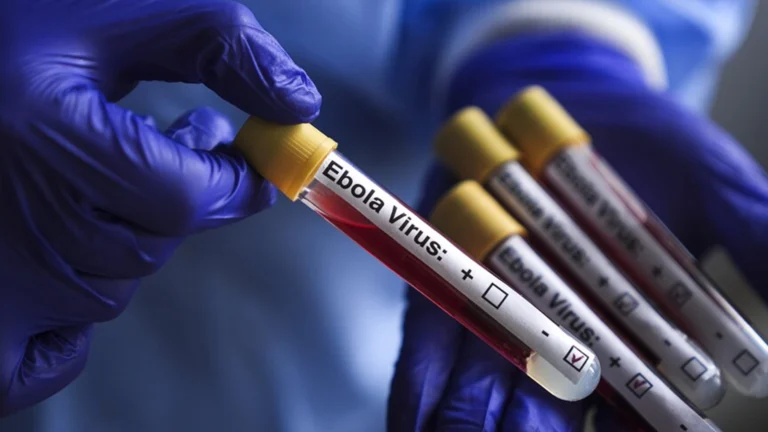
…as patient is advised to cooperate with health authorities on details of her movements before arriving Nigeria
Africa Centre for Disease Control and Prevention (Africa CDC) and Ugandan health authorities have disagreed on the origin of Nigeria’s index case of Ebola virus.

Director-General of the Africa CDC, Jean Kaseya, said the female patient was born in Uganda and had travelled to the country, where she spent several days before her husband joined her.
Kaseya told Channels Television that the couple returned to Abuja on October 3, adding that authorities were working with their counterparts in Nigeria, Uganda and the Democratic Republic of Congo (DRC) to establish the source of the infection.
“I am talking to Ugandan, DRC and Nigerian authorities, that the person we know today without any doubt, that this is a Ugandan-born person who went to Uganda and she was there for some days and the husband flew to join her in Uganda,” Kaseya said.
But he said it remained unclear whether the woman contracted the virus in Uganda or was infected elsewhere before travelling to Nigeria.
“What we know is that the lady came from Uganda, but what we don’t know is whether it is a transmission from Uganda, Kampala, or a transmission that came from another place. When we have answers to these questions, I will go back to Uganda and DRC to discuss the issue,” he said.
Kaseya advised the patient to cooperate with health authorities by providing details of her movements and possible contacts before arriving in Nigeria.
He added, “What we want is collaboration from this lady. She has to tell us, to disclose to the authorities; I need this information, Nigeria needs this information because we need also to support Uganda.
“These is the information we’re looking for that will help all of us and will prevent crises among African countries.”
Meanwhile, Uganda’s Ministry of Health had said the patient was Nigerian and had travelled to eastern DRC for business before transiting through Uganda in early October.
Uganda’s Director-General of Health Services, Charles Olaro, said the woman did not develop symptoms while in Uganda but became ill after arriving in Nigeria.
Ugandan authorities also maintained that the country had no confirmed active Ebola cases at the time of its statement, stressing that the patient’s passage through the country did not establish that she contracted the virus there.
“Travel through Uganda does not establish that infection occurred here. The location of exposure remains under investigation,” Olaro said.
On October 20, the Federal Government confirmed Nigeria’s first case of Ebola Bundibugyo virus disease, after laboratory tests detected the virus in a woman who had recently arrived in the country.
Coordinating Minister of Health and Social Welfare, Ali Pate, said the patient had been admitted in a private hospital in the Federal Capital Territory, where she received treatment before the diagnosis was confirmed.
On October 21, Director of Public Health Laboratory Services at the Nigeria Centre for Disease Control and Prevention, Olajumoke Babatunde, disclosed that the patient was a diplomat whose condition had deteriorated into multi-organ failure.
The differing accounts from the Africa CDC and Ugandan authorities have left questions about the location of the patient’s exposure unanswered, with investigations focusing on her travel history and possible contact with infected persons.
Kaseya said authorities needed to establish whether the woman had travelled to the DRC, had contact with anyone from the country or visited locations outside Kampala during her stay in Uganda.
He also appealed to African leaders not to politicise the outbreak or allow disagreements over the origin of the infection to undermine efforts to contain the virus.
“I know politics in Africa… I’m familiar with the politics in West Africa… my plea is clear to all leaders: we cannot play politics with this outbreak; we cannot point fingers; we cannot play isolation; we all need to come together to save our continent,” he said.
