


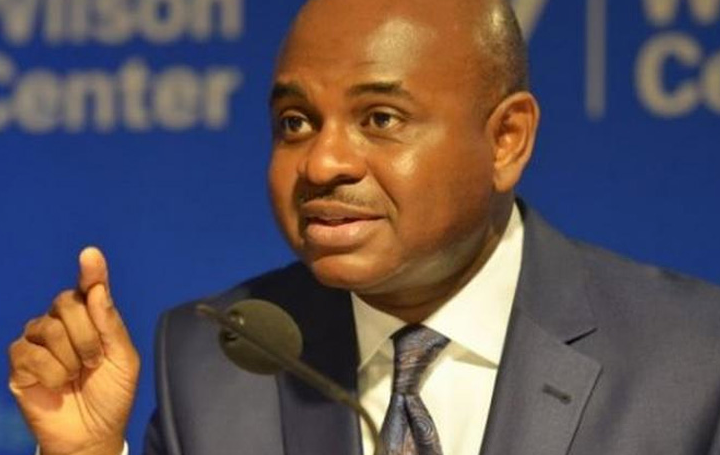
A former deputy governor of the Central Bank of Nigeria, Kingsley Moghalu says Nigeria’s level of productivity cannot support the N400,000 minimum wage the Nigeria Labour Congress and the Trade Union Congress are demanding.
Moghalu stated this on his official X handle on Tuesday.
On Monday, organised Labour had embarked on a strike over a new minimum wage and the recent hike in electricity tariffs for Band A customers.
NLC and the TUC have repeatedly proposed N615,500 and N494,000 as the new national minimum wage, citing inflation and the prevailing economic hardship in the country.
Moghalu noted that although the demand is deserving, it’s not realistic.
He therefore recommended a minimum wage of N75,000 to N100,000.
Moghalu said, “In the debates on the national wage in Nigeria, we miss the fundamental point: there is little or no productivity in the economy.
“If we had a truly productive economy, there is no reason we can’t have the kind of minimum wage of 400 or 500K that Labour wants. But we can’t, because the level of productivity in the economy cannot support it. Remember, the minimum wage is not just about government salaries.
“There are not more than 2, at most, 3 million civil servants in Nigeria. It is even more about what is paid in the private sector, to household staff, etc.
“All of this is why, all things considered, including avoiding a minimum wage that multiplies already ravaging inflation (assuming such a wage can even be paid), I recommend a minimum wage of between N75,000 and N100,000.”
The former CBN deputy governor further explained that productivity can be achieved by human capital development and electricity, amongst others.
He stated, “In fact, speaking about productivity, how productive is an average Nigerian worker? How skilled is he or she, and thus how much value does he or she create.
“I know we are all upset at our insensitive political class, who do not care about the masses and only for themselves. But the economics of it all is far more complex.
“Sadly, it is quite obvious that the political will to reduce the waste in governance does not exist.
“Human capital development. Skills that create value addition, which is economically quantifiable. Wealth creation and profitability increase. Wages go up naturally. And, of course, the almighty ELECTRICITY.”
Recently, Federal Government and organised labour reached an agreement to fix a new minimum wage that will be “above N60,000”.
