


By Gbenga Ayinde
Aliko Dangote’s $19 billion refinery rises from the Lagos coastline not merely as an industrial plant, but as a modern monolith of concentrated power, a landmark whose shadow stretches across Nigeria’s entire economic landscape. This is not the first time a single entity has sought to command the lifeblood of a nation’s economy. A century ago, John D. Rockefeller’s Standard Oil achieved a similar, suffocating dominance. Its power derived not from refining more kerosene, but from its ruthless control of the pathways to market (the secret railroad rebates and the stranglehold on pipelines that systematically choked off competitors).

Today, Dangote’s empire echoes this historic playbook, trading railroads for a private armada of trucks and leveraging a ‘zero-haulage’ model to dictate the very terms of market access. The fundamental question, therefore, transcends engineering: it is one of political economy. Will Nigeria learn from history and preempt the dangers of monopoly, or is it destined to repeat the struggle that once forced America to dismantle its own corporate giant?
The Dangote Refinery has done more than enter Nigeria’s downstream market; it has rewritten the rules. By fusing refining, logistics, and retail into a single command structure, it has collapsed the traditional fuel supply chain into a closed loop: crude in, petrol out, delivered by a private army of trucks, all priced at its sole discretion.
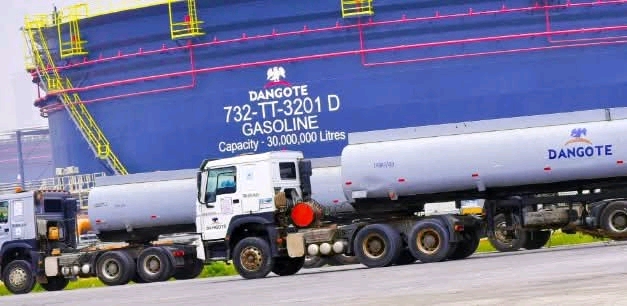
With 4,000 CNG-powered trucks already rolling and plans to double that fleet, complemented by private jetties and direct-to-station delivery, Dangote is no longer merely a refinery. It is an empire on wheels, engineered to capture the market before competitors like BUA or a new generation of modular refiners can even commission their first barrel.
Yet, for all its scale, dominance is not destiny. Every empire contains critical blind spots, and Dangote’s lies in his very strength: a massive, road-based distribution network. This impressive but inherently vulnerable system opens a flank that competitors can exploit not through direct confrontation, but through strategic asymmetry.
The pivotal insight is this: while Dangote owns the refinery, the veins of Nigeria’s energy system (the pipelines, tank farms, and depots) still remain a contested frontier. These assets can move fuel faster, cheaper, and more reliably than any fleet of trucks. This is not a battle to be fought on Dangote’s terms. It is a campaign to change the battlefield itself.
The Forgotten Advantage
Beneath the surface of Nigeria’s energy landscape lies a dormant giant: over 5,000 kilometers of petroleum product pipelines, stretching from Lagos to Kano, Warri to Maiduguri, Port Harcourt to Yola. Though many lie idle, victims of vandalism and neglect, they represent a capital-efficient skeleton for national distribution. Coupled with more than 100 strategically located tank farms, this network forms a dormant backbone that begs for revival, not reinvention.
While Dangote invests in wheels, competitors have a historic opening to invest in flow.
Consider the comparison: truck convoys are plagued by insecurity, extortion, crumbling infrastructure, and exorbitant maintenance. Pipelines, by contrast, offer continuous, uninterrupted delivery; a fraction of the cost per liter; a reduced environmental footprint; and near-total immunity to traffic, strikes, and roadblocks.
Yes, pipeline security is a challenge. But so is securing every truck on every mile of every journey. A pipeline is a fixed line that can be fortified and monitored with modern technology. A truck is a thousand moving targets. The strategic choice is simple: Dangote chose wheels. Competitors must choose pipes.
The Seven Strategic Levers: A Practical Playbook
For competitors, pivoting to a pipeline-and-depot partnership model isn’t a retreat, it’s a decisive repositioning that unlocks seven distinct advantages:
First and foremost, Speed. Pipelines move product 24/7. Journeys that take trucks days are completed in hours, making you the first to reach high-demand markets. Secondly, the Cost Advantage. By replacing hidden trucking costs with a pipeline alternative, you can compete sustainably on price without sacrificing margins. Third, the Last-Mile Alliance. The existing depot network is a ready-made distribution force. Integrating with them transforms potential casualties into powerful allies.
Furthermore, the Resilience Dividend: A distributed network of depots provides built-in redundancy. If one hub is compromised, others continue to flow, unlike a centralized fleet where a single point of failure can cripple the nation. Additionally, the Reliability arc. Where trucks are hostages to fortune (floods, protests, traffic jams) a secured pipeline offers a story of steadfast reliability that becomes a powerful market identity.
Sixth, the Retailer Loyalty Loop. Pipeline-fed depots can refill and turnaround a retailer’s tanker in a few hours. This operational efficiency builds fierce loyalty in a razor-thin margin business. Lastly, the Time-to-Market Blitz. In fuel retail, speed is the ultimate weapon. The first supplier to a dry station captures 100% of that demand cycle, securing preference and market share.
Coalition, Not Replication
The greatest strategic error would be to attempt to replicate Dangote’s all-in-one empire. For newcomers, this is financial suicide. The winning strategy is not conglomeration, but coalition-driven decentralization.
This means partnering with depot owners who control critical regional access, aligning with independent marketers who are desperate for an alternative to Dangote’s terms, engaging state governments hungry for stable, affordable supply for their constituents, and attracting international investors wary of the systemic risk posed by monopoly.
Imagine the alternative ecosystem: private and modular refineries feeding into a revived national pipeline grid. Regional depots, organized into a federation, distribute to retailers. Independent marketers thrive without fear of exclusion. This requires no duplication of Dangote’s billion-naira truck fleet, just a superior model of efficiency through connectivity.
If Dangote is the “telecom of oil”, owning the towers, the SIM cards, and the airtime, then competitors can become the “Google and WhatsApp of energy”: thriving not by owning every asset, but by empowering an entire ecosystem.
Owning the Roadmap
Dangote may have built Africa’s largest refinery, but production capacity does not equate to market control. History repeatedly shows that concentrated, centralized systems are vulnerable to more resilient, distributed networks.
Reliance Jio shook Indian telecom with free pricing, but Airtel survived by pivoting to premium fiber and digital services. Google dominates search, yet Apple, Amazon, and TikTok constantly reroute traffic and value. M-Pesa’s dominance in Kenya is now being challenged by agile fintech startups that offer interoperability and specialization.
The same disruption is possible in Nigerian energy, but only if rivals seize the pipeline advantage. The goal is not to match Dangote’s fleet truck-for-truck. The goal is to make the road logistical model obsolete.
The Sovereignty of Flow
Nigeria must not escape the trap of import dependency only to fall into the trap of domestic overconcentration. True energy sovereignty is not delivered by a single magnificent cathedral of industry, no matter how productive. It emerges from a competitive, distributed, and redundant ecosystem.
So, let Dangote own the roads. Let him command his empire on wheels. The strategic response is to own the pipes, to command the flow. Because in the final analysis, whoever controls the flow will ultimately win the market. And Nigeria wins only when no single player holds all the cards.
A Final Irony: Knowledge as the Ultimate Infrastructure
There is a profound twist to this analysis. In Promise, Paradox, Peril, I showed how vertical integration risks overconcentration. In The Cost of Zero Pricing, I argued that “free” always masks a hidden cost, paid by someone, somewhere. And yet, in crafting this trilogy, I too have participated in the free economy too. These insights arrive on your table at “zero.” No subscription. No consultancy fee. No haulage cost. Like Dangote’s refinery, I have borne sunk costs: time, research, and reflection.
But, the objective is not to skim the system or lock users in. The reward is more foundational: to sharpen public debate, to widen the gap of perspectives, and to place powerful tools of strategy directly into the civic commons.
This, perhaps, is the most virtuous form of the “free economy”, one where knowledge itself circulates as critical infrastructure, a strategic reserve of insight accessible to all. And if even one policymaker, one competitor, or one citizen is empowered to act, then the ultimate dividend will not be mine alone. It will belong to Nigeria.
. Gbenga Ayinde, a stakeholder in the oil and gas sector, writes from Lagos
