


From Idris Khalid, Bauchi
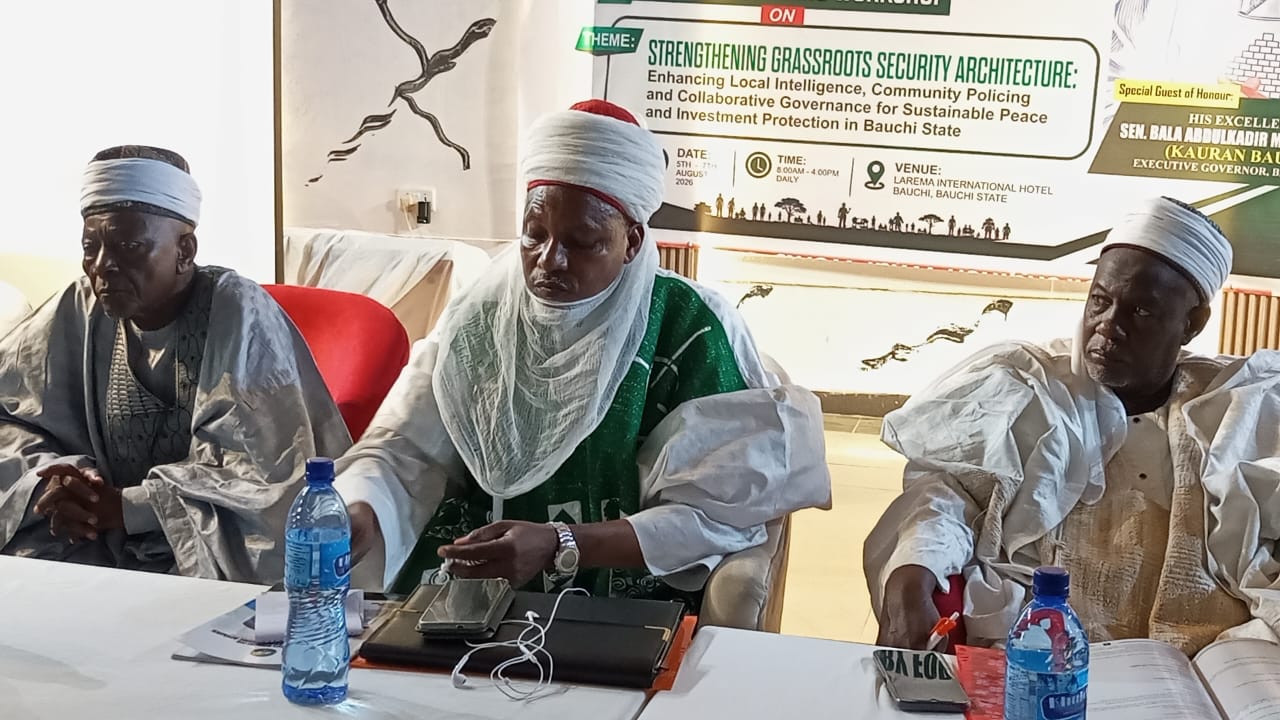
The Bauchi State Ministry of Internal Security and Home Affairs, in collaboration with Reading Academy Consultancy Ltd, has organised a three-day capacity-building workshop for traditional rulers, youth groups and community leaders aimed at strengthening grassroots intelligence gathering, community policing and collaborative governance for sustainable peace and investment protection.

The workshop, themed “Strengthening Grassroots Security Architecture,” commenced on Wednesday at Larema Hotel, Bauchi.
Speaking at the opening ceremony, the Chief Security Adviser to the Bauchi State Governor, DIG Sani Usman Mohammed (Rtd), said the programme was designed to establish effective community-based intelligence networks and strengthen early warning and early response mechanisms to enhance security, peacebuilding and sustainable development.
Represented by the Senior Special Assistant to the Governor on Internal Security, Babayo Liman, the security adviser stressed that security remains the foundation for sustainable development, peaceful coexistence and economic prosperity.
He noted that meaningful investment cannot thrive where insecurity persists, while governments cannot effectively deliver democratic dividends in communities living under constant threats of violence and criminality.
According to him, many parts of Nigeria continue to grapple with farmers-herders clashes, cattle rustling, kidnapping, rural banditry, communal conflicts and violent extremism, all of which threaten lives, livelihoods and socio-economic development.

He, however, said Bauchi State has remained one of the most peaceful states in the North-East due to the proactive leadership of Governor Bala Abdulkadir Mohammed and the commitment of traditional institutions, security agencies and community leaders.
Mohammed said the successful hosting of the Bauchi State Investment Summit 1.0 reflected the government’s determination to position the state as a preferred destination for both local and foreign investors.
He added that sustaining investors’ confidence requires a secure, stable and predictable environment where production, transportation and commercial activities can thrive without disruption.
According to him, strengthening community-based security mechanisms has therefore become a critical component of the state’s development agenda.
He identified Community-Based Intelligence Networks (CBINs), supported by Early Warning and Early Response (EWER) mechanisms, as globally recognised approaches to preventing insecurity.
The adviser explained that the system relies on active participation by traditional rulers, community leaders, local government authorities, youth and women groups, religious organisations, farmers, pastoralists and security agencies to detect emerging threats before they escalate into violent conflicts.
He said the workshop would equip participants with practical knowledge and skills needed to establish effective grassroots intelligence systems capable of preventing conflicts, promoting peaceful coexistence and strengthening the state’s security architecture.
“Community members are usually the first to notice suspicious movements, unusual behaviour, emerging disputes and criminal activities. Security is a shared responsibility that cannot be achieved by government or security agencies alone. Sustainable peace begins within communities through vigilance, trust, dialogue and timely sharing of credible information,” he said.
Also speaking, the Commander-General and Permanent Secretary of the Bauchi State Agency for Vigilante and Youth Empowerment, Alhaji Umar Shayi, said the workshop was intended to deepen participants’ understanding of Community-Based Intelligence Networks and improve collaboration among traditional institutions, local governments, security agencies and community organisations.
He said participants would also be trained to identify early indicators of insecurity, develop practical community action plans for intelligence gathering and conflict prevention, and promote trust, dialogue and information sharing among stakeholders.
Shayi described traditional rulers as the closest governance institutions to the people, noting that they possess extensive knowledge of their communities, family structures, migration patterns and historical relationships.
According to him, traditional rulers should monitor emerging tensions, facilitate mediation, encourage dialogue, promptly report security concerns and coordinate community peace committees.
He added that youth groups, women associations, farmers’ cooperatives, pastoralist organisations, market unions and faith-based groups must also actively participate in intelligence sharing and conflict prevention.
Shayi said the initiative aligns with Governor Bala Mohammed’s vision of consolidating the gains of the Bauchi State Investment Summit 1.0 by strengthening social cohesion, safeguarding investments and creating an enabling environment for inclusive economic growth.
He emphasised that traditional rulers, local governments, security agencies, community associations, pastoralist leaders and farmers’ organisations must work together as strategic partners in protecting lives and property.
According to him, institutionalised collaboration, continuous capacity building and community ownership of security initiatives would position Bauchi as a national model for intelligence-led peacebuilding and sustainable development.
He further noted that the long-term success of the state’s investment drive depends not only on attracting investors but also on creating a secure environment where investments can flourish safely and sustainably.
Delivering a paper titled “Traditional Conflict Resolution Mechanisms as a Tool for Sustainable Peacebuilding,” Muhammad Hadi Musa of the Department of Peace and Conflict Resolution, National Open University of Nigeria, described conflict as an inevitable feature of every human society.
He said disputes arising from differences in culture, religion, ethnicity, politics and competition over land, water and economic opportunities often become destructive when not properly managed.
According to him, recurring farmers-herders conflicts, communal disputes, youth violence, cattle rustling and banditry continue to threaten rural development and national security across Nigeria.
Musa observed that long before the emergence of modern courts, African societies relied on indigenous conflict resolution mechanisms rooted in dialogue, reconciliation, restorative justice and community participation.
He said traditional rulers, village heads, religious leaders, elders and women leaders played significant roles in preserving peace and strengthening social cohesion.
He maintained that integrating traditional conflict resolution mechanisms with formal governance and security institutions would significantly reduce violence, strengthen community resilience and promote sustainable peace.
Speaking on behalf of participants, the District Head of Miri, Alhaji Hussaini Othman Said, called on the Bauchi State House of Assembly to enact legislation empowering traditional institutions to play more effective roles in addressing insecurity.
He said traditional rulers command enormous respect within their communities and maintain a governance structure that extends from the family unit through village and district heads to the emirate, making them an indispensable link between the grassroots and government.
“Our traditional institution has a living structure that starts from the family unit to the village head, district head, emir, local government, state and federal government. This structure keeps us constantly in touch with what is happening at the grassroots,” he said.
He added that traditional rulers regularly provide intelligence to security agencies and educate residents against criminal activities.
According to him, security agencies would find it difficult to succeed in many rural communities without the support of traditional institutions, especially in villages where there are no police stations or courts.
The district head, however, urged the state government to provide legal backing for traditional rulers to strengthen their contribution to community security.
“At present, we do not have the legal authority to arrest offenders. Criminals sometimes exploit this limitation because we lack the powers to compel their arrest.
“If traditional rulers are given legal backing, just as Hisbah and the newly established forest security outfit have been empowered, we will be able to discharge our responsibilities more effectively and contribute even more to securing our communities,” he said.
