


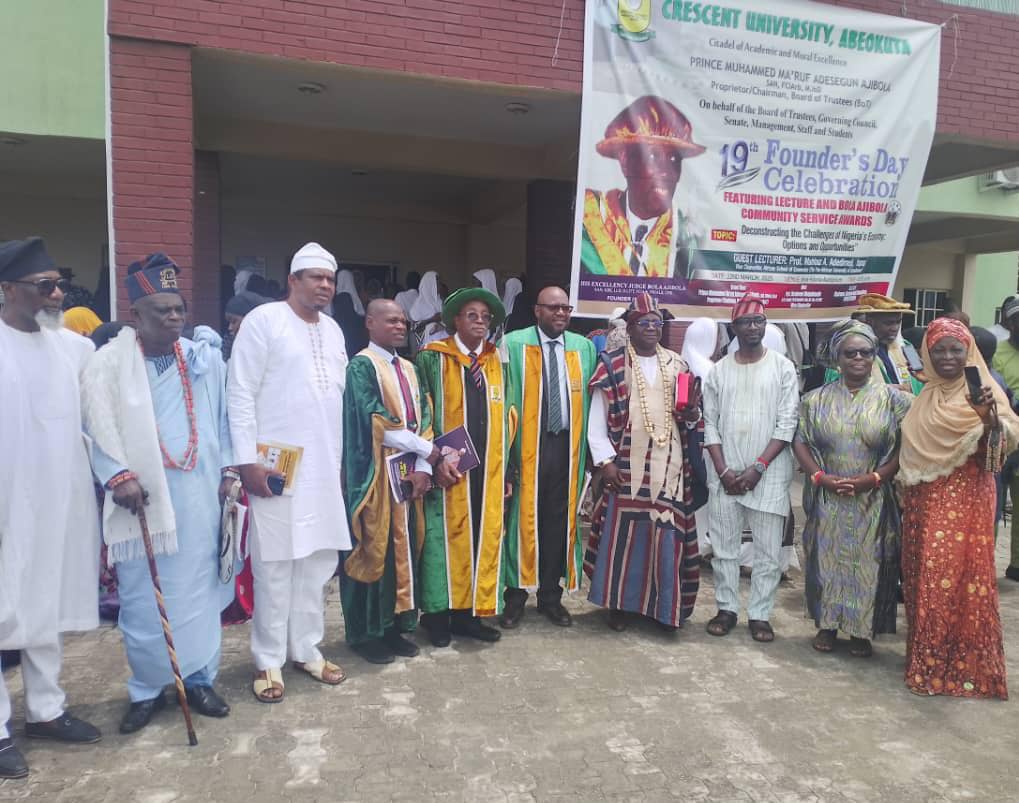
…as Crescent University celebrates 19th Founder’s Day
Segun Ayinde, Abeokuta
The Vice Chancellor, African School of Economics (The Pan-African University of Excellence), Prof. Mahfouz Adedimeji, at the weekend, warned that Nigeria’s over-dependence on oil would continue to negatively affect her diversification efforts in the areas of agriculture and mineral resources, thereby limiting economic growth.
Adedimeji, who spoke at the 19th Founder’s Day Celebration of Crescent University, Abeokuta, Ogun State, on the theme, “Deconstructing the Challenges of Nigeria’s Economic Reforms: Options and Opportunities,” said that until Nigeria stopped over-dependence on oil, its inflation would never cease to rise.
He lamented that Nigeria continued to face economic challenges, including high employment rates, infrastructural deficits, hunger and poverty, despite being endowed with abundant human and mineral resources, due to her over-dependence on oil revenues, which had stunted its economic growth.
The VC also expressed regret that since the discovery of oil in commercial quantities, the country had relied heavily on petroleum exports as its primary source of revenue, resulting in the neglect of other critical sector such as agriculture, manufacturing and solid minerals.
He urged the President Bola Tinubu-led administration to invest in local production, especially in agriculture, industries and digital economy to reduce inflation and create employment opportunities for youths so as to put an end to the ‘Japa syndrome’ among young graduates and citizens of the country.
Adedimeji, therefore, called on every home owner in the country to cultivate mini-farmlands in their various homes to grow crops, not only to combat hunger, but to also be cautious of what they eat, stressing that most food Nigerians eat are preserved with chemicals which are injurious to health
He said, “It is affecting negatively and the only thing we can do, for us to reduce inflation, is to increase what we are exporting. The global fluctuation in oil prices is not really helpful to the Nigerian economy and the only way we can sustain our economy is to increase our domestic production in favour of our food sufficiency so that we will not always be importing.
“The oil sector will continue to serve its purpose through our oil exchange but it is not going to be oil-dependent. A mono-cultural economy is no longer sustainable; we have to go back to agriculture. We have to go back to mining industry. We have to go back to exploring the opportunities in digital economy.
“Do do not forget that in today’s world of economy, it is not the size that really matters, it is the intellect that matters. We have to invest in our youths so that they will be able to drive the economy so that they will be able to find here in Nigeria the opportunities that they are looking for abroad.
“But in a situation whereby our young ones migrate abroad, there will be no one to develop the economy of the country. I think the government should make agriculture attractive to the young graduates so that everybody wil be able to plant what they eat.”
Both the Vice-Chancellor, Prof. Ibraheem Gbajabiamila and Chairman of the Board of Trustees, Prince Ma’ruf Ajibola of Crescent University, Abeokuta, lauded the founder’s vision in their separate speeches, noting that the Founder, Prince Bola Ajibola dedicated his wealth to establishing the university in 2005 with the aim of enhancing human capacity development in Nigeria.
The university also gave awards to dignitaries, including late Towulade of Akinale, Owu Kingdom, Ọba Olufemi Ogunleye; the Odofin of Egbaland, Chief Kolawole Akintoye and a movie producer, Mr Adesegun Akinlotan for their commitment to humanitarian services.
