


For former Ogun State Commissioner for Health and one-time Senator representing Ogun Central, Prof Iyabo Obasanjo, one aspect of politics she appears determined not to leave to chance is grassroots mobilisation.
In her reckoning, political engagement is not something to be conducted from the comfort of an office or through intermediaries. It is a business of physical presence, personal interaction and sustained identification with the people.

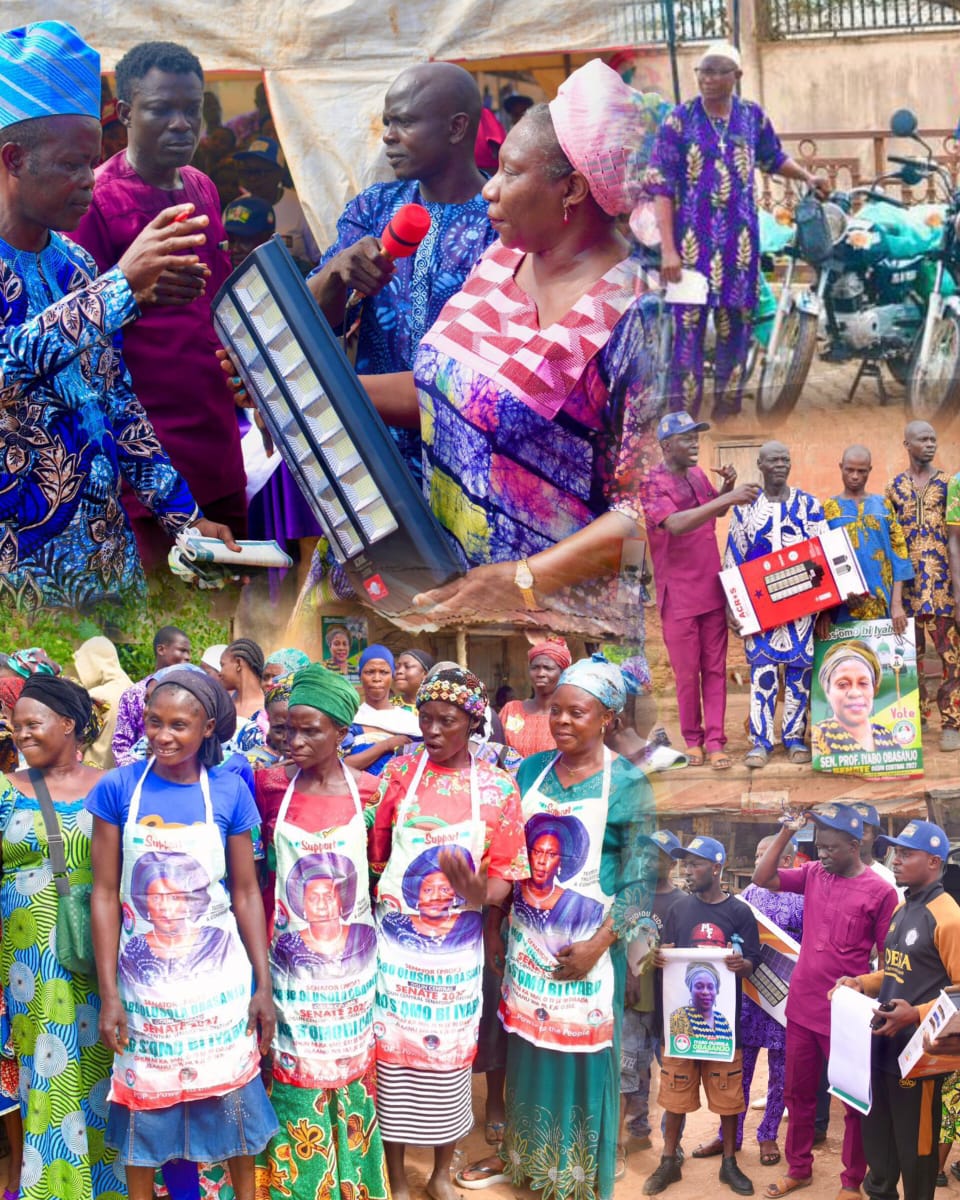
That philosophy has, in recent days, come to the fore as Senator Obasanjo has embarked on an intensive grassroots mobilisation drive across communities in the Senatorial District, traversing several hinterland settlements in Ifo, Ewekoro and Odeda Local Government Areas.
Within just four days, the former Senator has taken her campaign to a long list of communities, where she has not only met residents and community leaders but also distributed empowerment items and other materials designed to bring immediate relief and practical assistance to the people.
Among the communities where massive empowerment presence have reached are Ibogun, Iyana Egbado Adubu, Akinbo, Temu, Babalawo/Kajola, Olugbo, Sanyaolu Olobe, Deyi, Odeda, Eseke, Ikeku, Edila, Bantun, Amusan, Odelaitan, Adulu, Lalemi, Mongoro, Emulu, Ntoji and Osiele.
Across the communities, the atmosphere has reportedly been one of celebration, interaction and renewed political engagement, with residents and community leaders turning out en-masse to receive the Senator and her entourage.
At the heart of the exercise has been an unmistakable message: Iyabo Obasanjo intends to fight for every vote and is prepared to go wherever the people are.
For Senator Obasanjo, this approach is hardly a new political strategy invented for the present contest.
Her longstanding relationship with grassroots communities dates back years, including her period as Commissioner for Health in Ogun State and her first stint in the National Assembly as a Senator elected on the platform of the Peoples Democratic Party(PDP).
Her Iyaniwura Foundation, which has for years provided a platform for interaction and support among ordinary people, has also remained an important vehicle through which she has maintained contact with communities at the grassroots.
It is this familiarity with the people—and the ease with which she interfaces with them—that appears to distinguish her style of mobilisation.
At the various stops, Senator Obasanjo has been seen mingling freely with residents, exchanging banters, listening to their concerns and interacting with people across social and economic classes.
For her, the grassroots is not merely an electoral constituency to be visited during election season. It is a constituency where relationships are cultivated and sustained. This aspect is widely believed to be an area of political advantage in her favour when compared to her fellow co-contestants in the race.
That disposition was particularly evident in Ibogun, in Ifo Local Government Area, the ancestral home of the Obasanjo family and a community with which Senator Iyabo has a deeply personal connection.
Ibogun is also where she casts her votes during elections.
Rather than make a hurried political appearance, Senator Obasanjo reportedly spent virtually the entire day during the weekend moving around the community, visiting family personalities, political allies and other stakeholders.
The visit provided an opportunity for extensive interaction with residents and community leaders, with the Senator once again demonstrating her characteristic ease among ordinary people.
The pattern was repeated in several other communities visited by the campaign team.
Solar lighting equipment and other empowerment items were distributed to residents in many locations while Senator Obasanjo used the opportunity to engage directly with community leaders and ordinary citizens.
At Mango Community of Oke-Ata in Abeokuta, Senator Obasanjo also donated a transformer to address the electricity challenge of the people.
The emphasis appeared to be on practical intervention rather than political rhetoric alone.
For many of the beneficiaries, the items represented something tangible they could take home, while for the Senator, the exercise offered another opportunity to strengthen the bonds between herself and the communities.
Community leaders across the various locations reportedly expressed support for her aspiration, with many attributing their disposition to her previous interventions and what they described as her longstanding identification with their communities.
The endorsements were said to be anchored not simply on the current political contest but also on memories of her years of service as Health Commissioner and Senator, as well as the assistance associated with her grassroots initiatives.
The intensity of the current mobilisation suggests that Senator Obasanjo is taking nothing for granted in her bid to return to the Senate.
Earlier on Monday, she took the mobilisation effort another step further by presenting brand-new motorcycles to Coordinators of her campaign organisation across the six Local Government Areas that make up Ogun Central Senatorial District.
The gesture was clearly targeted at strengthening the campaign’s grassroots operational capacity, giving coordinators greater mobility as they move across wards and communities in pursuit of support.
The six local government areas of Ogun Central provide a vast political terrain, stretching from urban centres to deeply rural communities. Effective mobilisation across such a constituency requires not only political structures but also the ability to physically reach voters.
The motorcycles are therefore expected to assist the coordinators in sustaining contact with communities, wards and supporters as the campaign gathers momentum.
For Senator Obasanjo, the message appears straightforward: there will be no waiting for the election to arrive before building the structures required to win it.
What is emerging from the current mobilisation is a picture of a candidate who understands that elections are ultimately decided by people—and that people respond not only to political promises but also to relationships, accessibility and a sense of belonging.
Senator Obasanjo’s interactions with the communities have therefore gone beyond formal campaign speeches.
There have been handshakes, laughter, banters, visits to homes and personalities, meetings with community leaders, empowerment programmes and direct engagement with residents.
It is a deliberately personal style of politics. And nowhere does she appear more comfortable than at the grassroots.
Whether among community leaders, farmers, artisans, traders, youths or elderly residents, the Senator has continued to project herself as someone who can descend from the political heights and engage ordinary people on their own terms.
That ability, her supporters believe, could prove crucial as the Ogun Central contest intensifies.
With the latest four-day tour of communities and the simultaneous strengthening of her campaign machinery, Senator Obasanjo appears to be sending a clear signal to political opponents and supporters alike that she is approaching the contest with determination.
She is not leaving the mobilisation of the grassroots to chance. She is not relying exclusively on political structures. And she is certainly not waiting until the eve of the election before reaching out to voters.
Instead, she is taking the campaign directly to the people—community by community, ward by ward and settlement by settlement.
From Ibogun to Odeda, from Ifo to Ewekoro and through the numerous smaller communities that constitute the backbone of Ogun Central, Senator Obasanjo is putting in the hours and investing heavily in personal contact.
For her supporters, the strategy is simple: win the confidence of the people first, build the machinery second and then take that confidence to the ballot box.
And if the pace of the past four days is anything to go by, Senator Iyabo Obasanjo appears ready to give the Ogun Central Senatorial race everything she has.
For a politician whose career has been shaped by both public office and direct engagement with the people, the current mobilisation may ultimately be less about rediscovering the grassroots than returning to familiar territory with renewed determination.
In Ogun Central, Senator Obasanjo appears to have drawn the battle line—and, judging by the intensity of her current engagement, she intends to fight for every inch of political ground.
