


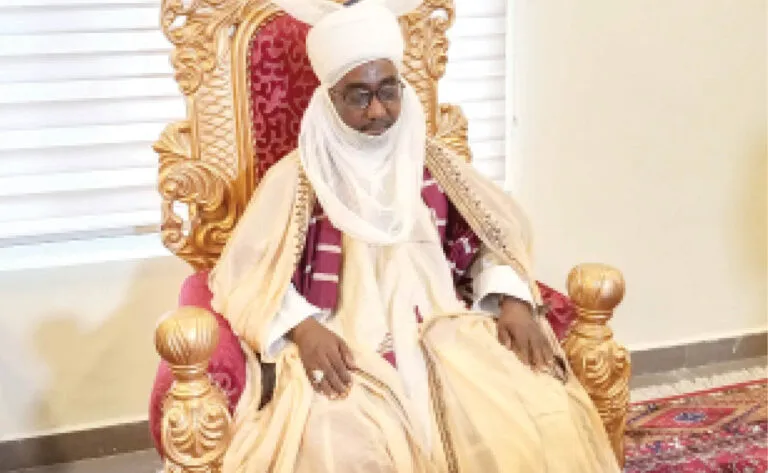
The Emir of Zazzau, Alhaji Ahmed Nuhu Bamalli, has said he has never saved enough money for the period required to pay monetary zakat in his life.
Zakat, one of the five pillars of Islam, is an obligatory payment on qualifying wealth when it reaches the prescribed minimum threshold, known as nisab, and satisfies other conditions, including the applicable period of ownership.

For monetary wealth, the commonly used rate is 2.5 per cent after qualifying savings have remained at or above the nisab for a lunar year.
However, the monetary value of the threshold varies with the prevailing value of gold or silver and scholarly methodology.
As of September 2026, the official Zakat Nisab in Nigeria fluctuates daily based on market values, but the latest tracked figures place the gold-based Nisab at around ₦15,654,875, while the silver-based Nisab sits at roughly ₦1,722,571.
Bamalli said his personal savings had never met the conditions that would require him to pay monetary zakat.
“I have never given out monetary zakat in my life because I have never saved money for the period to be able to pay zakat,” he said.
When asked to clarify whether he had never paid zakat, the emir replied: “I have never saved enough money.”
He said this was simply how he lived his life, adding that he was at peace with his approach to personal wealth.
“Yes, that’s how I live my life. I have never done that. And I live in peace,” Bamalli said.
The emir spoke in an interview with Weekend Trust ahead of his sixth anniversary on the Zazzau throne.
Bamalli, a lawyer, banker and former diplomat, said he had never considered wealth accumulation a priority despite holding several senior positions before becoming emir.
He served as Nigeria’s ambassador to Thailand with concurrent accreditation to Myanmar and previously worked in the banking sector.
He also served as executive director and acting managing director of the Nigerian Security Printing and Minting Corporation.
According to him, his attitude towards wealth was also shaped by his upbringing, recalling that his father left behind only N11,000 and five pieces of cloth when he died.
“I didn’t see any reason why I should accumulate wealth because my father left nothing,” he said.
Bamalli also rejected the suggestion that he had accumulated money in preparation for his emergence as the 19th Emir of Zazzau.
“I didn’t have anything. The only money in my account was the Foreign Service allowances we were given like salaries every month; that’s all,” he said.
The emir said he currently has only one house in Zaria and another in Abuja, stressing that he had never been driven by the desire to accumulate material possessions.
Bamalli said his philosophy of leadership was also incompatible with the pursuit of wealth and material accumulation.
“Leadership is not about accumulation, it is not about vanity or flamboyance or anything, it is about service to the people, service to humanity,” he said.
He added that he had sworn by the Quran to be fair and just to the people of the Zazzau Emirate.
“My prayer is to be remembered as a just leader; that’s all,” Bamalli said. rather than an avenue for personal enrichment.
He said he regularly reads a book by Abdullahi Fodio which, according to him, reminds him of the responsibilities of leadership and the consequences of failing to discharge them properly.
“Sometimes I feel as if I’m not going to see the gates of heaven if I don’t do the right thing,” Bamalli said.
The emir said he was less concerned about being remembered for wealth or status than for how he treated the people under his authority.
“My prayer is to be remembered as a just leader; that’s all,” Bamalli said.
(Daily Trust)
