


President Bola Tinubu has shunned a special envoy from South African President Cyril Ramaphosa, declining to personally receive the presidential delegation from Pretoria.
This is just as the Federal Government on Monday strongly condemned the recurring xenophobic attacks against Nigerians and other African nationals in South Africa, urging the country’s authorities to take urgent and concrete steps to end the violence.

Tinubu, it was learnt, directed Ramaphosa’s delegation, led by South Africa’s Minister of International Relations and Cooperation, Ronald Lamola, to meet with the Minister of State for Foreign Affairs, Amb Sola Enikanolaiye, who is expected to brief him after the talks.
It was gathered from Presidency sources that although the South African delegation arrived in Nigeria’s capital city, Abuja, on Friday, bearing a message from President Ramaphosa, the Nigerian President declined a meeting with them following the diplomatic tension generated by the recent attacks on Nigerian citizens living in South Africa.
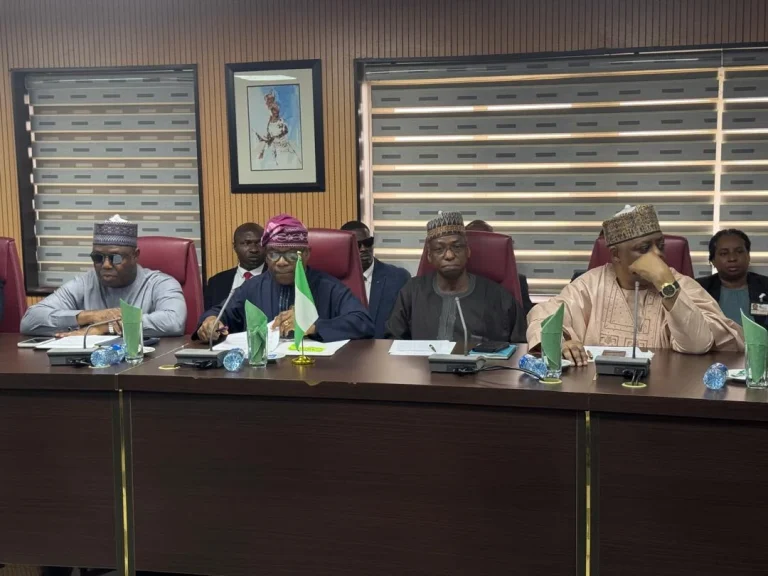
A Presidency source said the South African delegate was at the Aso Rock Presidential Villa on Friday requesting to meet with President Tinubu. But since there was no prior notice from the South African government, the delegation request was turned down.
But President Tinubu on Monday directed the Minister of State for Foreign Affairs, Ambassador Enikanolaiye to meet with the South African delegate and brief him afterwards.
Another Presidency source confirmed that Tinubu had no meeting scheduled with the delegation, but a third source said Foreign Affairs Minister, Bianca Odumegwu-Ojukwu, who is currently in Addis Ababa, Ethiopia, advised that it was not the appropriate time for the President to receive the South African President’s delegation because South African citizens back in their country were continuing in their attacks on Nigerians and their businesses.
Addressing the South African delegation in Abuja, Amb Enikanolaiye said President Tinubu directed the meeting to exchange views on resolving the attacks, stressing that the long-standing strategic relationship between both countries should not be undermined by violence against African migrants.
The Nigerian Minister of State for Foreign Affairs, who expressed disappointment with the attitude of South Africans citizens towards Nigerians in their country, recalled Nigeria’s support for South Africa’s liberation from apartheid and the strategic partnership both countries later forged through the African Union and the New Partnership for Africa’s Development.
According to him, “It is with profound pleasure that I welcome our brothers from South Africa. President Bola Ahmed Tinubu had actually asked us to meet with you and exchange views and perspectives on how to address and resolve the ongoing Afrophobic attacks in South Africa, of which Nigerians and other citizens of Africa have been victims.”
Enikanolaiye expressed disappointment over what he described as a persistent pattern of attacks in the past 30 years.
He said, “We have seen a pattern emerge as early as 1995, 1998, 2006, 2015, 2016, 2019, 2021, 2024 and 2026.
“From 2022 alone, 98 Nigerians have died in mob actions and hate-related attacks that we have described as Afrophobia because Africans, particularly Nigerians, are the predominant victims.”
The Minister emphasised that while Nigeria does not condone criminality, anyone accused of an offence should be prosecuted in accordance with the law rather than subjected to mob justice.
“The Nigerian government will not support drug peddlers, but what we are saying is that anyone accused of an offence should be treated in accordance with your constitution, international human rights instruments and the minimum requirements of humanity,” he said.
Enikanolaiye added that many Nigerians legally residing in South Africa had also become victims of attacks, expressing deep worries over instances where South African security agencies allegedly failed to intervene.
He added, “If someone is, quote-unquote, a criminal for drug trafficking, there are rules, there are regulations for when they are arrested, prosecuted, and jailed.
“The Nigerian government will not support drug peddlers, but please, what we’re saying is that treat them in accordance with your constitution, in accordance with international human rights instruments, in accordance with the minimum requirement of humanity.
“But what we have found is that this xenophobic act has gone beyond the attack on criminals. We have records of Nigerians who have a legitimate purpose to remain in South Africa, yet they have been attacked.
“We could see some mob actions, where we saw the police watching, as if they are helpless to address this situation, which to us raises issues of state responsibility. It raises issues of complicity. If the state authorities are not able or unwilling to tackle these challenges.”
The minister also recalled the humanitarian consequences of previous attacks, saying Nigeria had evacuated nearly 1,500 citizens from South Africa.
“I shed tears in the plane when I saw children, women and the elderly returning home with almost nothing. Some had their properties looted and destroyed,” he said.
The meeting is coming several weeks after a fresh wave of xenophobic violence that erupted in April prompted Nigeria to approve evacuation flights for stranded citizens, with more than 1,000 Nigerians registering for voluntary repatriation.
The South African Minister, Lamola, in his response, said Ramaphosa sent him to Abuja to reaffirm South Africa’s opposition to xenophobia and other forms of intolerance.
“We have been outspoken against any intolerance, including xenophobia, racism, homophobia, violence and discrimination directed at individuals within our borders,” he said.
But he maintained that South Africa would continue to enforce its immigration laws and tackle criminal activities.
“President Ramaphosa has also been very firm on South Africa’s sovereign right to enforce immigration laws, including dealing decisively with irregular migration, undocumented immigrants and acts of criminality committed within our borders,” Lamola added.
The South African Minister described migration as a continental challenge requiring joint action by African countries, expressing optimism that continued dialogue between Abuja and Pretoria would help ease the current diplomatic tension.
Diplomatic relations between Nigeria and South Africa have deteriorated sharply following repeated attacks on Nigerians and other foreign nationals in South Africa.
Recently, the House of Representatives recommended the suspension of business permits for South African companies operating in Nigeria, while the Senate dispatched a delegation to Pretoria to formally register Nigeria’s displeasure over the attacks with the South African government.
