


Troop shortage and poor welfare may be exposing military commanders to increasing terror attacks, findings by Saturday PUNCH have shown.
Soldiers, security analysts, including retired military officers, who spoke to our correspondents, said the attacks were designed to weaken the military’s command structure and instil fear within the ranks.
The Islamic State West Africa Province intensified its campaign in 2025 when it launched what it described as the “burning of the camps” or “Camp Holocaust”, a coordinated strategy aimed at crippling the operational capacity of security forces by focusing on military formations.
The renewed onslaught resulted in the killing of more senior officers in multiple attacks across Borno State, North-East.
The Institute for Economics and Peace, in its Global Terrorism Index 2026, published in March, ranked Nigeria fourth among countries with the deadliest terror attacks.
According to the report, ISWAP regained its position as the deadliest terror group in the country, carrying out more than 90 attacks that resulted in 384 deaths in 2025.
10 senior officers killed in seven months
Findings by Saturday PUNCH showed that no fewer than 10 senior military officers, including two brigadier generals, were killed between October 2025 and April 2026.
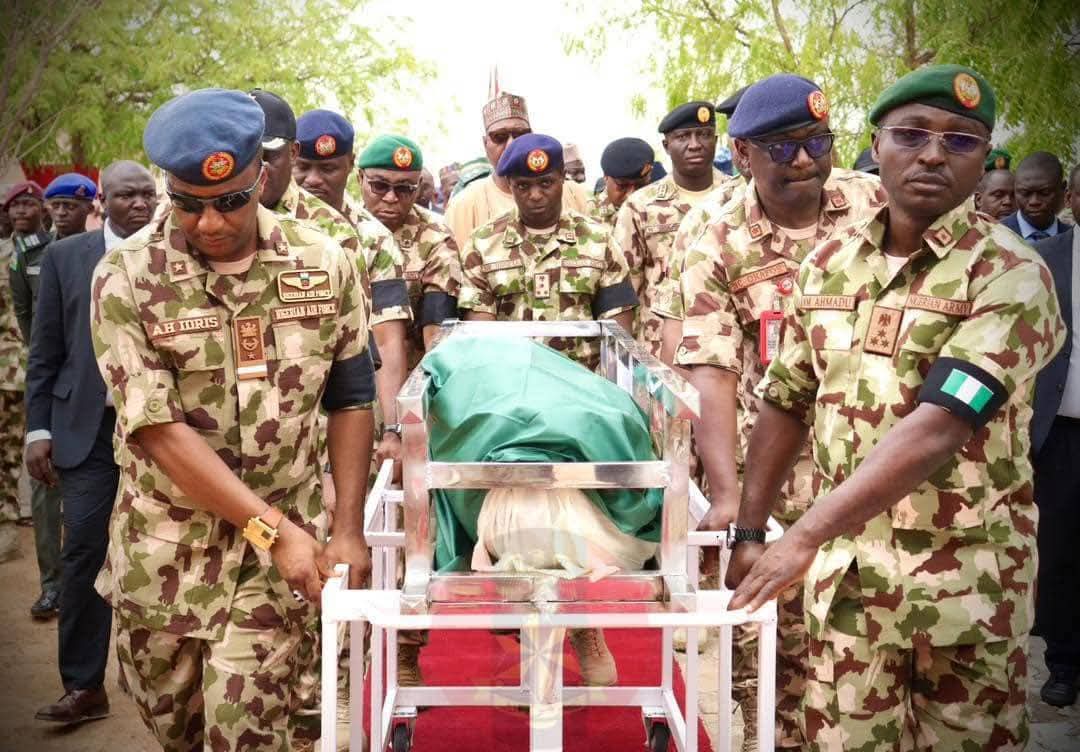
The latest casualties were Brigadier General Oseni Braimah and Captain Ismail, who died during an attack on a military base in Benisheikh, Borno State, on April 9, 2026.
They were buried on Wednesday at the Maimalari Cantonment Cemetery in Maiduguri.
Similarly, a commanding officer and six other soldiers of the Joint Task Force (North-East) Operation HADIN KAI were killed by an improvised explosive device in Monguno, Borno State, on April 12.
According to a statement by the Media Information Officer of the North-East Joint Task Force, Sani Uba, troops had earlier engaged insurgents in a fierce gun battle, forcing them to retreat while maintaining control of the area.
However, the commanding officer was killed shortly after the encounter when he moved to the frontline to assess the situation and stepped on an IED.
Other casualties include Col. Aliyu Paiko, Commanding Officer of the 202 Battalion in Bama Local Government Area, who was killed alongside other soldiers in October 2025, and Brigadier General Musa Uba, who died near Wajiroko after ISWAP fighters ambushed troops along the Damboa–Wajiroko road.
Also killed were Maj. Umar Mairiga, who died on March 1, 2026, during an attack on a military formation in Mayenti, Bama LGA; Lt. Col. S.I. Iliyasu, Commanding Officer of 222 Battalion, killed on March 6 in Konduga; Lt. Col. Umar Farouq, killed on March 9 when insurgents overran a base in Kukawa LGA; Lt. Ismaeel Baba; and Major Segun Amusan.
Manpower shortage affecting morale – Soldier
A soldier serving in the North-East blamed poor welfare and manpower shortage for the declining morale among troops.
Speaking with Saturday PUNCH, the soldier said many personnel lacked the motivation to risk their lives without assurances about the welfare of their families.
“Do you know the number of soldiers in a battalion, brigade or division? Each of these formations has a standard strength. A battalion, for instance, should have between 500 and 1,000 soldiers. But if you go round the battalions in Borno State and across the North-East, you will hardly find any with up to 1,000 personnel. The truth is, there is a serious manpower shortage.
“Also, our welfare is poor, and this is very important. What we are being given is not enough. We are just struggling. Many of us would have left the job, but we have nothing else to fall back on. So we remain, trying to take care of our families.
“Let me give you an example. Recently, troops dealt a heavy blow to terrorists in Malam Fatori. A day before that operation, N30,000 was paid into every soldier’s account. That alone boosted morale, and everyone woke up happy. Go and check how we are fed, you will pity us. Everything they are doing is wrong,” the soldier added.
He noted that in some cases, troops were dislodged by insurgents not because they were overpowered, but due to low morale, stressing that many soldiers were unwilling to risk their lives.
The source said the Nigerian Army’s difficulty in attracting new recruits to fill the vacuum created by fallen soldiers and deserters had worsened manpower shortages within the force.
There have been reported cases of personnel exiting the service prematurely, with some soldiers said to have deserted due to dissatisfaction with welfare conditions, operational pressures, and perceived lack of adequate support for troops in active theatres of war.
Saturday PUNCH reports that despite repeated nationwide recruitment drives, responses have remained low in some regions, especially the South-East and South-South, where enlistment figures are reportedly below expectations.
Security analysts and military sources noted that the situation has contributed to a widening recruitment gap, as many eligible youths continue to show reluctance to join the military despite sustained appeals and enlistment campaigns.
The Delta State Governor, Sheriff Oborevwori, recently appealed to qualified youths in the state to take advantage of about 400 recruitment slots allocated to the state.
In 2025, the Army raised the alarm over the poor enlistment of South East youths into the military, and called for a change of attitude to reverse the trend.
Why senior officers are targeted
Security experts, including retired military officers, linked the rising deaths of senior officers to what they described as a shift in the nature of the conflict and a deliberate targeting strategy by insurgents.
They also attributed the trend to the increasing exposure of senior officers on the frontlines, driven partly by inadequate troop strength and slow recruitment into the armed forces.
Speaking with Saturday PUNCH, a retired Lieutenant Colonel, Abdulwahab Ademola, said although senior officers were not traditionally expected to be at the frontlines, they often operated close to combat zones to coordinate operations.
He explained that commanders typically remain within a short distance of active engagements to effectively monitor and direct troops in what he described as a “fluid battlefield.”
However, he noted that the dynamics of asymmetric warfare had made such proximity increasingly risky.
Ademola warned that insurgents were now deliberately targeting the military’s ‘centre of gravity’.
By focusing on commanding officers responsible for planning and coordination, he said insurgents aimed to disrupt operations and weaken troop morale.
“The current wave of attacks on senior military officers is a new trend. The insurgents are targeting the centre of gravity, that is, what you destroy to render the rest ineffective. Once commanders are taken out, the units can fall into disarray.
“They are no longer just targeting soldiers; they are going after those responsible for planning operations. Once that happens, the military becomes disoriented.
“This strategy is aimed at disorganising and demoralising personnel. By targeting the leadership, they ensure that troops are unable to regroup effectively for combat. When the commander is removed, the rest of the unit is thrown into confusion,” Ademola said.
He also pointed to the growing use of ambushes and Improvised Explosive Devices as a major threat to troop movements.
According to him, these tactics, often deployed along routes used by military personnel, are designed to inflict maximum damage and create uncertainty within the ranks.
“This is a very dangerous development because these threats are embedded within the same environments where troops operate,” he said, stressing the need for effective early warning systems.
To counter these threats, Ademola called for the adoption of modern technology and a review of military operational strategies.
He noted that tools such as drones could help detect ambushes, buried explosives and hostile movements before troops advance.
He further raised concerns about gaps in communication and response systems, noting that junior officers often lack the authority or tools to call in immediate support, including air power, during engagements, leading to dangerous delays.
‘Politicians sponsoring insurgency’
An intelligence officer at the Defence Headquarters also attributed the targeting of senior officers to a deliberate attempt by insurgents to demoralise troops.
The officer, who spoke on condition of anonymity, said the strategy was aimed at creating the impression that terrorists were winning the war.
“Those terrorists have introduced psychological warfare by targeting theatre commanders. They want to demoralise our troops and create the impression that they are winning, which is not the case.
“We have eliminated thousands of them and destroyed their operational bases,” he said.
The officer, who had led several operations, also blamed politicians for the worsening insecurity, alleging that some were sponsors of insurgency.
“We need to appeal to our politicians to stop playing politics with people’s lives. They are the sponsors of these terrorists. They know them and are shielding them,” he added.
Military infiltrated – NAF officer
Similarly, an Air Force officer who previously operated in Borno State before his redeployment alleged that terrorists had infiltrated the military, making it easier to track and target commanders during operations.
He said some personnel had been compromised and were acting as informants for insurgents.
“If you look at how these terrorists have been killing operational commanders, it shows they are acting on intelligence. They know the routes and timing of troop movements, and that can only happen with insider collaboration.
“Our commanders must find a way to flush out the bad eggs within the system. The government has invested heavily in training these senior officers, and they should not be lost in this manner.
“We are already overstretched. Losing generals and other leaders on the battlefield will further weaken troop morale,” he said.
Also speaking, a security expert, Chigozie Ubani, described the killings and increased exposure of senior military officers as a troubling development that reflects deeper systemic challenges within Nigeria’s security architecture.
Ubani, a fellow of the Institute of Security Nigeria, said insurgents were exploiting the situation to instil fear among officers, making deployments to conflict zones more psychologically daunting.
He also linked the attacks to possible infiltration within the military, warning that insider compromise could be aiding insurgent operations.
According to him, the shortage of personnel has compelled commanders to operate closer to active combat zones than traditionally required, as they strive to maintain control and coordination during missions.
This, he said, has placed senior officers in direct danger during ambushes and attacks.
“There is a deliberate effort by insurgents to inflict as many casualties as possible. It is a calculated strategy. When a commander is killed, the next officer posted to that area becomes unsettled.
“If a general is deployed to such a location, his family will be anxious about his safety. From the outset, there is fear, and that alone can affect performance. It is part of their war strategy.
“They also aim to discourage military postings to the North, especially to active conflict zones. Their goal is to gain control of territories. They impose taxes and assert authority, which suggests they see themselves as a form of government.
“This trend has persisted across administrations, from Goodluck Jonathan to Muhammadu Buhari, and it is still ongoing,” Ubani said.
‘Global networks fuelling attacks’
On his part, security and policy analyst, Dr Kabir Adamu, said the targeting of senior officers points to a more coordinated and deliberate approach by insurgent groups such as Boko Haram and ISWAP.
He explained that recent directives from global extremist networks had encouraged affiliated groups to intensify attacks, particularly against military leadership.
According to him, gaps in Nigeria’s counter-terrorism strategy, especially in disrupting funding, recruitment and logistics, have enabled insurgents to sustain their operations.
“The Jama’atu Ahlis Sunna Lidda’awati wal-Jihad, also known as Boko Haram, and ISWAP are becoming more deliberate in their attacks against the Nigerian military and government.
“These groups are linked to global extremist networks. In February, a directive was issued urging affiliates, including those in West Africa, to intensify attacks.
“Our senior military officers are being deliberately targeted. Insurgent leaders have instructed their fighters to focus on military formations and, particularly, leadership structures,” he said.
Adamu also highlighted funding challenges within the security sector, noting that delays or inadequate releases had affected recruitment, training and overall preparedness.
He added that limited recruitment and delays in training had stretched existing personnel, leaving fewer troops to cover wider operational areas and increasing risks for deployed officers.
He warned that without urgent efforts to boost manpower through sustained recruitment and improved deployment strategies, senior officers would remain vulnerable during operations.
Military formations in isolated locations – Ex-general
In his view, Brigadier General Bashir Adewinbi (retd.) said the vulnerability of senior officers was not necessarily due to deliberate targeting alone, but also the harsh conditions under which troops operate, particularly in remote and poorly supported locations.
He explained that many military formations are stationed in isolated areas far from major operational bases, making reinforcement and logistics difficult.
Citing the distance between Maiduguri and some frontline areas near the Chad border, he said movement between locations could take up to a day, leaving troops exposed.
According to him, the absence of forward operational bases has worsened the situation, as personnel often struggle to access basic supplies such as food and water.
“Sometimes, troops receive supplies that can only last a day. That is not sufficient for sustained operations,” he said.
Adewinbi also identified weak coordination between different arms of the military, particularly the army and air force, as a major limitation.
“They often operate in isolation, which is not ideal, especially when facing large numbers of insurgents,” he said.
Adewinbi warned that insurgents, who often move in large groups on motorcycles and exploit porous borders, can overwhelm poorly supported military formations.
“The strength of a brigade cannot withstand hundreds or even thousands of attackers moving rapidly,” he said.
‘Military bases lack adequate protection’
The retired general further attributed the losses to inadequate protection of military bases and gaps in intelligence gathering, stressing the need for improved surveillance and early warning systems.
He called for greater deployment of technology to enhance intelligence gathering, detect threats early and improve communication between units.
“They need better logistics, improved communication and stronger protection. Without these, they remain vulnerable,” he said.
Adewinbi added that improving supply chains, establishing closer support bases and strengthening coordination across military units would significantly reduce casualties among both senior officers and troops on the frontlines.
Nigerian military dominance in peace-keeping mission
Despite the growing strength and evolving tactics of insurgent groups, security analysts say Nigeria’s military record in external peacekeeping operations presents a contrasting picture that raises questions about its domestic counter-insurgency performance.
They note that Nigerian troops have, over the years, earned commendation for professionalism and operational effectiveness in international deployments, particularly under the Economic Community of West African States Monitoring Group missions in Liberia and Sierra Leone in the 1990s, where they played leading roles in stabilising the sub-region during prolonged civil wars.
Against this backdrop, the analysts argue that the prolonged and complex nature of the fight against Boko Haram and ISWAP within Nigeria has exposed deeper structural and operational gaps that require closer scrutiny.
They further note that while insurgent groups have become more adaptive and increasingly reliant on asymmetric warfare tactics, the divergence between Nigeria’s external peacekeeping successes and its domestic counter-insurgency challenges underscores the need to reassess key issues such as manpower strength, equipment adequacy, intelligence coordination and troop welfare in determining operational effectiveness on home soil.
Attempts to contact the spokesperson for the Nigerian Army, Lieutenant Colonel Onyinyechi Anele, were unsuccessful as of the time of filing this report.
(Punch)
