


By Prof. Lucky B Adesoga
There are moments in politics when a word acquires a life of its own, travelling beyond intention into an atmosphere already charged with suspicion and fear. By the time the explanation arrives, the damage may already have travelled much further.

Osun has had one such moment in the controversy surrounding Senator Francis Fadahunsi and a video in which he appeared to tell supporters to kill members of the Accord Party. Fadahunsi has maintained that he was speaking metaphorically, meaning political defeat rather than physical harm, and has sought to explain the remarks within the context of alleged attacks on APC supporters. The controversy has nevertheless triggered police questioning and calls for action, adding another layer of tension to an already combustible political environment.
The episode matters because it exposes something larger than the meaning of one politician’s words. It raises a question about the kind of political culture Osun wants to carry into the next four years. Must politics be a permanent contest of provocation, accusation and theatrical confrontation, or can political competition return to the business of ideas, competence and responsible leadership?
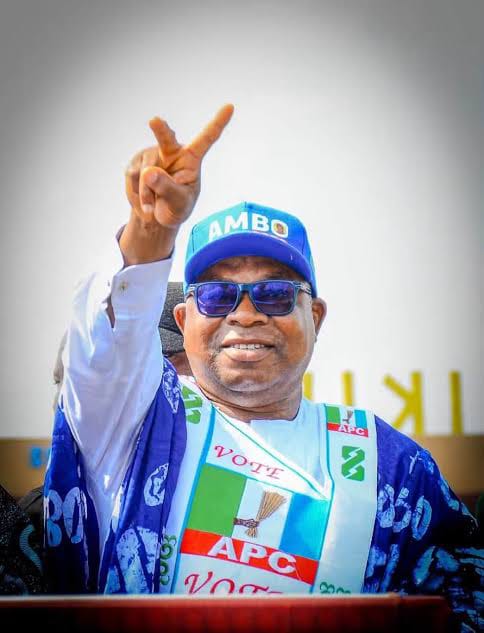
That is where the argument for Bola Oyebamiji, popularly known as AMBO, becomes significant.
The significance of AMBO in the Osun contest extends beyond his emergence as the governorship candidate of the All Progressives Congress. His political proposition offers a different temperament from the increasingly toxic atmosphere surrounding the election.
AMBO’s public positioning has consistently emphasised calmness, competence and the seriousness of governance. In September 2025, long before the present intensity of the campaign, Oyebamiji described governance as “serious business” and argued that radicalism was no qualification for governing a state.
That distinction cannot be overstated. Politics can be noisy. Governance cannot afford to be. A politician can win applause with a dramatic gesture, an incendiary statement or a memorable performance. A governor, however, has to manage a payroll, balance competing demands, attract investment, maintain infrastructure, improve schools, strengthen healthcare, create jobs and ensure that public resources produce public value. The two disciplines are not interchangeable.
This is where the idea of an “AMBO sanitising effect” acquires meaning. Leadership style matters. The disposition of the person seeking to occupy the highest political office in the state can influence the behaviour of the political organisation around him. A candidate who treats politics as permanent combat can encourage combat around him. A candidate who insists that elections are democratic contests rather than warfare can begin to change the atmosphere.
Oyebamiji has made his position very clear. Following a shooting involving party members in June, he called on the police to investigate and described political violence as unnecessary, stressing that elections should not be treated as warfare. “If we begin to kill our own people, who then are we going to govern?” he asked.
That is more than campaign rhetoric. It is a statement of governing philosophy.
The distinction becomes even more important when placed against the background of the Fadahunsi controversy. The appropriate response to inflammatory language is a higher standard of political conduct.
If Fadahunsi intended “kill” in the metaphorical sense of defeating an opponent at the polls, then he should make that meaning unmistakable and reject violence against political opponents. If allegations of attacks on APC supporters contributed to his anger, those allegations should be investigated. Neither grievance nor provocation provides a licence for political language that can reasonably be understood as encouraging physical violence.
That should be the standard for everybody.
It is also why the Fadahunsi episode cannot be turned into a stain on AMBO or the entire APC campaign. Individual statements should be judged on their own merits. The candidate should be judged by his own words, conduct and record.
On that score, Oyebamiji has offered voters a consistently clear proposition: governance should be approached as a management responsibility.
There is substance behind that proposition.
Before entering electoral politics, Oyebamiji built a career spanning banking, public finance and public administration. He served as Managing Director of Osun State Investment Company Limited, later became Commissioner for Finance in Osun State and subsequently headed the National Inland Waterways Authority.
His record at NIWA is particularly relevant because it offers a practical test of the managerial identity he now presents to Osun voters. During his tenure, NIWA introduced the National Inland Waterways Transportation Code and established Water Marshals to enforce safety regulations. According to Oyebamiji, the Water Marshals grew from 80 to 350 during his tenure, while safety campaigns were expanded across the Authority’s operational bases.
The broader record has also attracted commendation. In February 2026, Minister of Marine and Blue Economy Adegboyega Oyetola praised reforms at NIWA under Oyebamiji for improving revenue, operational efficiency, stakeholder collaboration and regulatory oversight. Oyebamiji was also recognised by the Coalition of Maritime Journalists with a “Most Media Friendly Maritime CEO” award, with transparency and accessibility cited among the reasons for the recognition.
These are the attributes of a political philosophy built around institutional performance. They point towards an idea that Osun urgently needs: government is an institution to be managed, not a stage on which the governor performs.
That is also the logic behind the Osun Prosperity Agenda, the seven-point programme unveiled by Oyebamiji in May 2026. Its framework, PROSPER, covers poverty alleviation, workers’ welfare and job creation; responsive and accountable governance; opportunities for economic growth; security and social protection; productive agriculture; education and healthcare; and infrastructure, culture and tourism.
The significance of the agenda is that it connects the candidate’s managerial identity to a governing framework.
The underlying proposition is straightforward: prosperity does not happen because a governor is popular. It happens because institutions work.
This brings the debate back to the question of public resources.
The controversy over an alleged ₦13.7 billion annual payroll fraud has become one of the most serious fiscal questions surrounding the Adeleke administration. The allegation has been disputed by the Osun government, which has questioned aspects of the audit and its findings. Even a disputed allegation raises an important governance question: how confident can citizens be that the systems responsible for identifying, paying and supervising public servants are working properly?
That is precisely the sort of question a manager should welcome rather than evade as though it were somehow above his pay grade.
The issue is bigger than one payroll controversy. Osun needs a government that can account for every naira it receives, explain its priorities and demonstrate the connection between expenditure and outcomes. A state cannot build prosperity on applause. It requires financial discipline, institutional competence and the ability to turn plans into measurable results.
This is where the AMBO proposition becomes more interesting than a conventional campaign slogan. His appeal rests on the proposition that he is a different kind of political operator: one whose experience has been shaped by targets, institutions, budgets, administration and delivery.
There is also something culturally resonant in this proposition. Osun’s political tradition has long been associated with the Yoruba idea of the Omoluabi: character, responsibility, self-restraint, respect and service. Those values sit uneasily with politics that treats opponents as enemies to be eliminated rather than fellow citizens to be defeated at the ballot box.
The “sanitising effect” therefore requires standards within the political organisation itself. Every political organisation contains competing interests, ambitions and personalities. The candidate can, however, choose the political culture he wants to reinforce.
Oyebamiji appears to understand this. His public interventions on political violence have been remarkably consistent. When violence erupted, he called for investigation. When fears of intimidation surfaced, he urged voters not to be afraid. When the campaign environment became tense, he insisted that elections should be peaceful.
That is the beginning of sanitisation.
This is particularly relevant to the APC’s battle against toxic politics. The party cannot credibly argue that Osun needs a different political culture while tolerating inflammatory conduct from its own ranks. Its candidate cannot ask voters to reject political violence while remaining silent when supporters cross the line. The standard must apply internally as well as externally.
That is why AMBO’s strongest political asset may ultimately be the opportunity he represents to embody a different conception of political leadership.
A governor does not need to be the loudest person in the room. He needs to be the person capable of making the room work.
On August 15, Osun voters will make a choice. INEC has fixed the governorship election for that date. The choice before them should therefore be larger than the personalities competing for the office.
They can choose politics as spectacle, where performance, provocation and personality dominate public attention. Or they can choose a politics in which competence becomes the central currency, institutions matter, public money is treated as a public trust and political opponents remain citizens after the votes have been counted.
That is the real meaning of the AMBO proposition.
The Fadahunsi controversy has shown once again how quickly political language can become toxic. The answer to toxic politics is a political alternative capable of changing the temperature of the contest.
This is where the “AMBO sanitising effect” matters. It is the possibility that the politics of Osun can move from provocation to purpose, from theatre to management, from personality to performance, and from the politics of confrontation to the business of governing.
For the APC, that is the battle worth winning. For Osun, it is the choice worth making.
. Prof Adesoga writes from Ibadan, Oyo State
