


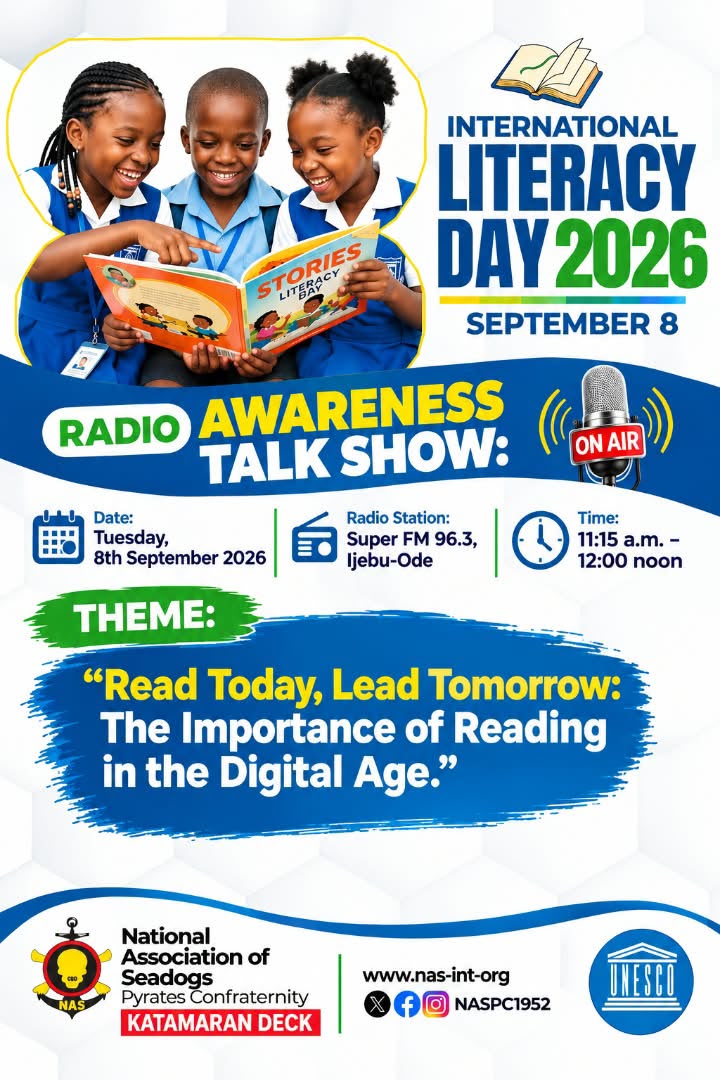
…as live radio awareness talk show holds in Ogun
The Katamaran Deck of the National Association of Seadogs, popularly called Pyrates Confraternity and the Head of the Department of English, Olabisi Onabanjo University, Ago-Iwoye, Dr Kemi Olayemi, have stressed the need to preserve and sustain the culture of reading inspite of the threats posed by contemporary digital platforms.

The Katamaran Deck comprising Ijebu-Ode and Remoland, as well as the university don expressed their concerns as they joined communities and organisations around the world to mark the 2026 International Literacy Day with a radio awareness talk show designed to promote reading, literacy consciousness and responsible engagement with information in the digital age.
The 45-minute programme, held on Tuesday, September 8, 2026, was broadcast live on Super FM 96.3, Ijebu-Ode, between 11:15 a.m. and 12:00 noon. It was organised around the theme, “Read Today, Lead Tomorrow: The Importance of Reading in the Digital Age,” and provided an opportunity for listeners to reflect on the continuing importance of literacy at a time when digital technology, social media and other forms of electronic communication increasingly influence the way people acquire and process information.
The live radio programme featured the Head of the Department of English, Olabisi Onabanjo University, Ago-Iwoye, Dr Kemi Olayemi, as guest speaker, while Kinyomi Olugbenga, popularly known as Family Professor, anchored the programme for Super FM 96.3, Ijebu-Ode.

The radio programme combined discussion, storytelling, audience participation and reading activities in an effort to make the observance of the special day both informative and engaging.
Speaking during the programme, Dr Olayemi explained the significance of literacy and reading to individual development and the advancement of the society.
According to her, “Literacy goes beyond the ability to read and write,” stressing, “A literate individual should also be able to understand, interpret and apply information meaningfully.”
The university don encouraged parents, teachers, young people and members of the public to take practical steps to sustain the culture of reading despite the distractions created by contemporary digital platforms.
Speaking in the same vein, Cap’n of the Katamaran Deck, Jamal Apena, noted that “the ability to read and understand information remains particularly important in an era in which people are confronted daily with enormous quantities of information from social media, the internet, television and other digital platforms.”
During the programme, attention was given to the changing reading habits of young people in the digital age.
The discussion examined the influence of social media, short-form digital content and the increasing dependence on electronic devices.
While acknowledging the benefits of technology as a source of information and learning, the programme also drew attention to the need for discipline and critical thinking in the consumption of digital content.
The highlight of the live radio programme was the Children’s Reading Corner, which introduced younger participants to the importance of storytelling and reading.
The segment featured children readers, Bolatito Majekodunmi and Ademuyiwa Ogunye, who presented the traditional Nigerian folktale, Olurombi.
Their reading created an opportunity for young listeners and other members of the audience to encounter literature through an entertaining and participatory format.
The story also generated thoughtful reactions from listeners who called in to the programme. One of the callers, reflecting on the lesson she derived from the story, said the major lesson for her was that people should always learn to wait on the Lord.
Her response demonstrated how a traditional story could stimulate personal reflection and invite listeners to draw moral and philosophical lessons from literature.
Another important dimension of the children’s presentation was the lesson identified by the young readers themselves. In reflecting on Olurombi, the children explained that one should not make promises that cannot be fulfilled. Their interpretation added a particularly significant dimension to the reading session, as it demonstrated that children can engage with stories beyond simply reading the words and can identify moral lessons from the narratives they encounter.
The responses from the callers and the children illustrated the interactive character of the programme. Rather than treating reading as a passive activity, the session encouraged listeners to interpret, question and relate the lessons of literature to everyday life.
The exchange also demonstrated how storytelling can provide a simple but effective means of communicating values to younger members of society. The inclusion of Olurombi further demonstrated the value of indigenous stories in contemporary literacy advocacy. Traditional narratives remain important vehicles for preserving cultural memory and transmitting moral values from one generation to another. By bringing such a story into a modern radio programme, the organisers connected Nigeria’s storytelling heritage with contemporary efforts to promote reading.
Explaining the decision of Katamaran Deck to commemorate the day through a radio awareness programme, the Cap’n of the Deck, Comrade Jamal Apena, said the choice was informed by the need to take literacy advocacy beyond conventional physical events and reach a wider section of the community through a medium that people could easily access.
Apena stated that the “International Literacy Day provides an important opportunity to draw public attention to literacy as a foundation for education, personal development, informed citizenship and community progress.”
He further stressed that “the ability to read and understand information remains particularly important in an era in which people are confronted daily with enormous quantities of information from social media, the internet, television and other digital platforms”.
The Cap’n explained that Katamaran Deck deliberately opted for a radio programme because radio remains an accessible and influential medium within the local community.
He noted that a radio discussion could reach people in their homes, workplaces, shops, vehicles and other locations without requiring them to physically attend an event.
This medium of mass communication, he added, also provides an opportunity for direct interaction between experts and members of the public.
According to him, “Reading should not be restricted to academic requirements or examination preparation, but should be regarded as a lifelong habit capable of expanding knowledge, improving communication, strengthening critical thinking and opening opportunities for personal and professional development.”
Apena also emphasised the responsibility of parents, schools, communities and other stakeholders to create an environment that encourages children and young people to read.
The radio programme therefore served not only as an observance of the International Literacy Day but also as a platform for public education on responsible information consumption.
Through the participation of the university don, a professional radio presenter, children readers and members of the listening public, the initiative connected literacy with education, culture, technology, citizenship and community development.
The choice of the theme, “Read Today, Lead Tomorrow: The Importance of Reading in the Digital Age,” also reflected the organisers’ emphasis on the relationship between reading and leadership.
The programme further reinforced the idea that individuals who develop strong reading and comprehension skills are better positioned to acquire knowledge, make informed decisions and participate meaningfully in society.
The participation of children in the reading segment further demonstrated the Deck’s interest in promoting literacy among younger members of the community.
By introducing children to storytelling and reading in an engaging radio environment, the programme sought to present reading not simply as a school obligation but as an enjoyable and rewarding activity.
For Katamaran Deck, the radio awareness talk show represented another dimension of its community-oriented activities.
The initiative demonstrated how an organisation can use an international observance as an opportunity to address a local social issue and connect global themes with the everyday experiences of people within its immediate environment.
The live radio programme ended with renewed emphasis on the need to sustain the culture of reading in spite of the rapid growth of digital technology.
The central message was that technology should complement rather than replace meaningful reading, learning and critical engagement with information.
Through the International Literacy Day radio awareness talk show, the Katamaran Deck of the National Association of Seadogs (Pyrates Confraternity), succeeded in bringing the conversation on literacy directly into the homes and everyday spaces of members of the public.
The initiative also reinforced the Deck’s commitment to public enlightenment and community development, while demonstrating that radio remains a powerful platform for reaching diverse audiences and stimulating conversations on issues of social importance.
