


From Idris Khalid, Bauchi
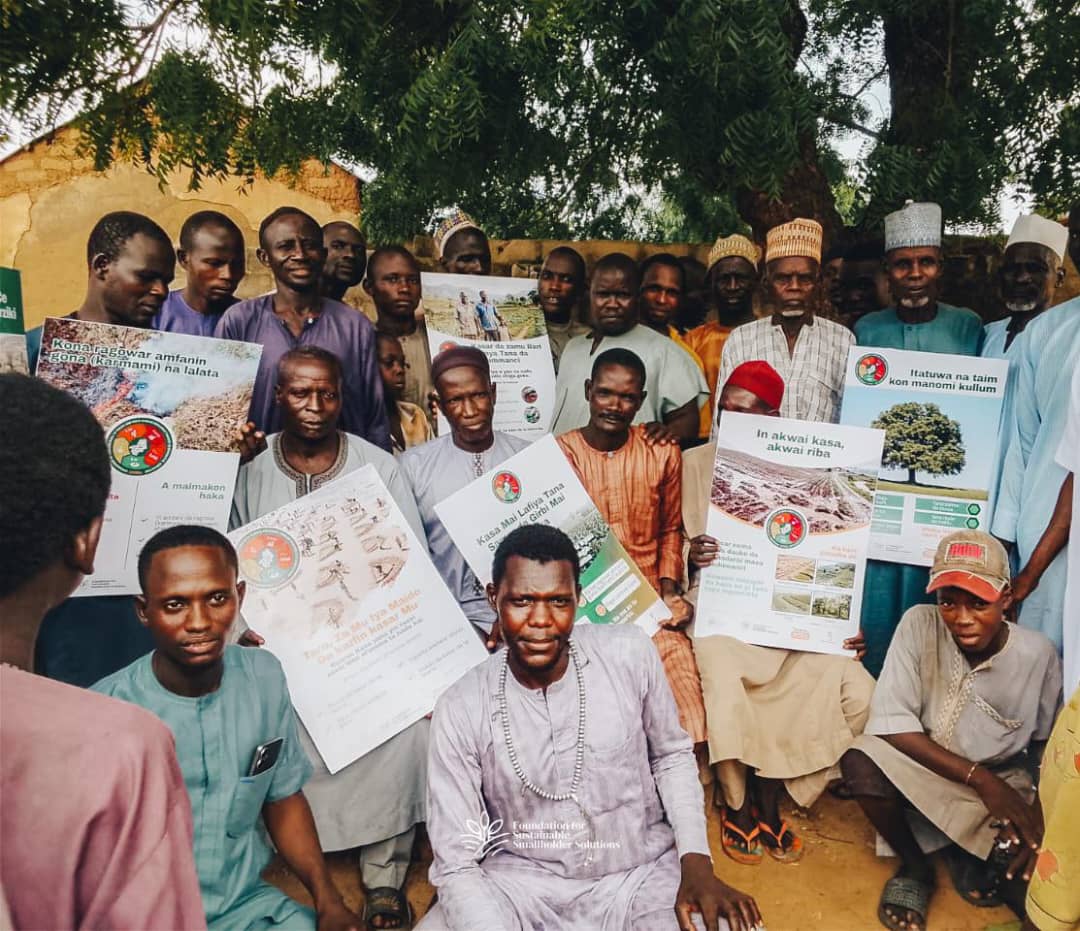
More than 21,000 farmers across seven local government areas (LGAs) in Bauchi North have been reached through a Social and Behaviour Change Communication (SBCC) campaign implemented by the Foundation for Sustainable Smallholder Solutions (FSSS) to promote climate-smart and regenerative farming practices.

The campaign is aimed at addressing harmful agricultural practices contributing to bush burning, deforestation, declining soil fertility, erosion and land degradation, which have increased farmers’ vulnerability to drought and unpredictable rainfall.
Speaking yesterday on the intervention, FSSS Brand and Communications Manager, Clinton Mena Inene, said the campaign used community mobilisation and practical training to encourage farmers to adopt sustainable approaches to farming and natural resource management.
He said farmers were sensitised on tree planting and protection, prevention of bush burning, soil conservation, water management, mulching, composting, manure application and other organic fertilisation methods.
According to him, farmers were also introduced to earth bunds and half-moons as techniques for reducing erosion, slowing water runoff and improving rainwater infiltration into the soil.
“The campaign reached more than 21,000 farmers, including women and young people,” Inene stated.
Farmers who participated in the training said the sessions had improved their understanding of practical measures they could adopt to protect their farms and respond to climate-related challenges.
A farmer from Katagum LGA, Musa Abdullahi, said the training had changed his approach to soil management.
“Before now, I used to burn the residues on my farm because I thought it was the easiest way to clear the land. From the training, I learned that the residues can be used as mulch and compost to improve the soil. I will stop burning them and use them to support my crops,” he said.
Similarly, a female farmer from Giade LGA, Hauwa Ibrahim, said the lessons on water conservation would help reduce crop losses during periods of irregular rainfall.
“The training taught us how to make earth bunds and half-moons to keep water on the farm. This is important because rainfall is no longer predictable. I will apply what I learned so that my crops can receive more water and grow better,” she said.
Another farmer from Shira LGA, Abdullahi Sani, said the training encouraged him to plant and protect trees around his farm.
A female farmer from Jama’are LGA, Zainab Umar, said the training had increased her confidence in using organic materials to improve soil fertility.
“We were shown how to use manure and compost instead of depending only on chemical fertiliser. This will help us improve our soil and reduce the cost of farming. I am ready to share the knowledge with other women in my community,” she said.
Inene said behavioural change was essential to ensuring that climate-resilience interventions produced lasting results.
“It is not enough to give farmers inputs and tools. They also need to understand why these practices matter and how the choices they make on their farms affect the land and their livelihoods,” he said.
Farmers were also introduced to services available through FSSS Farmers’ Hubs, including improved seeds, agricultural inputs, training, mechanisation, climate information and market opportunities.
The SBCC campaign forms part of the wider Empowerment of Smallholder Farmers to Thrive and Build Climate Resilience through Regenerative Agriculture (ESTRRA) Project, which aims to directly reach 14,000 smallholder farmers and contribute to the restoration of 29,000 hectares of degraded land across Bauchi North.
The ESTRRA Project is being implemented with funding support from the HEINEKEN Africa Foundation and Nigerian Breweries PLC.
