


By Segun Olatunji
If political wishful thinking were an Olympic sport, A.R. Olanrewaju would currently be biting into a shiny gold medal. Reading his latest op-ed is like watching a dramatic Nollywood thriller where the suspense is completely fabricated, yet the soundtrack insists we should all be panicking.

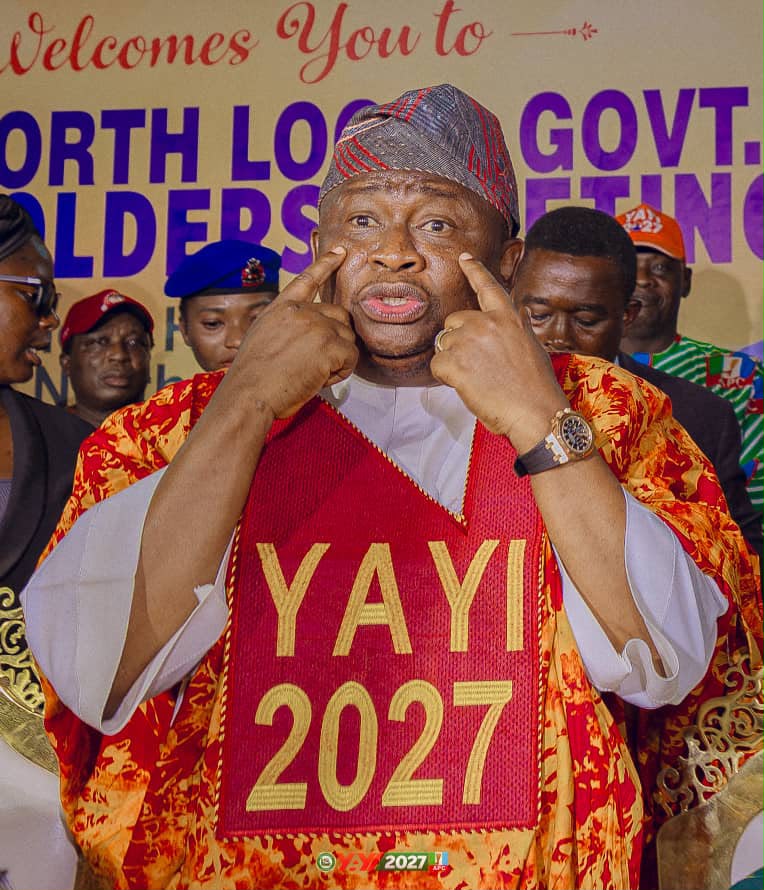
According to Olanrewaju, one lively afternoon rally in Abeokuta has somehow vaporised years of concrete infrastructure, grassroots empowerment and statewide goodwill. Apparently, in Olanrewaju’s political universe, building too many roads, hospitals and schools is now a fatal campaign flaw—and Senator Solomon Olamilekan Adeola, universally known as Yayi, is supposed to be trembling in his boots over his own receipts.
The Great “Roots” Debate vs. Actual Receipts Across All Three Districts
First, let us salute the sheer stamina of the opposition for dusting off the “where is he really from?” talking point every four years like a favourite Sunday agbada. Whenever critics run out of policy ideas, they suddenly become amateur genealogists. Meanwhile, ordinary people across Ogun’s three senatorial districts are far more interested in who is fixing their potholes than who is drawing family trees on Twitter.
Olanrewaju airily dismisses roads and school buildings as mere trinkets that “cannot, on their own, guarantee public acceptance.” What a brave take from the comfort of a keyboard! Perhaps he should try explaining that theory to the folks actually using Yayi’s projects across the state:
- In Ogun West: As the sitting Senator, Yayi has rolled out over 270 infrastructure projects, turning his home district into a live-action construction zone. From the 103km Ilara–Ilashe Road and the Town Hall/Oju Ile Road in Iboro (Yewa North), to the Intensive Care Unit at the State Hospital in Ilaro, an ICT centre at the School of Nursing, and modern markets and classroom blocks across Yewa South, Ipokia, Imeko-Afon, and Ado-Odo/Ota, the receipts are literally paved in asphalt.
- In Ogun Central: Even though he does not constitutionally represent the district, Yayi has been busy upgrading Egba communities anyway—how terribly rude of him. Residents in Abeokuta are driving on newly constructed roads like the Olokuta Idi Aba–Train Station Road, the Alamala–Olorunda Road, and community roads around Mile 2 and Crescent University, alongside the 3km Ifo–Ibogun Road in Ifo LGA. Throw in 3,000 traders boosted by his Market Women and Men Support Fund in Ogun Central alone, and you can see why the opposition is sweating.
- In Ogun East: Yayi’s “unpopularity” somehow followed him straight into Ijebu and Remo land. He facilitated the Mini Campus Link Road and Limelite Road in Ago-Iwoye (Ijebu North), gave the iconic Ojude Oba Pavilion in Ijebu-Ode a facelift, and kicked off a four-storey hospital building plus new roads in Ijebu North East. Over in Ogun Waterside, he has planted over 2,000 solar streetlights and worked to reconnect more than 25 communities to the national electricity grid
Across all three districts, add over 330 transformers, thousands of scholarships, and business grants for 10,000 market traders. In the real world, voters have a funny habit of liking the guy who treats the entire state as his constituency long before campaign posters hit the walls.
Politics in the Gateway State has always been a game of strategic alliances, proven capacity and grassroot reach—not bedtime stories whispered to soothe anxious rivals. When election day finally arrives, Ogun voters will not walk into polling booths armed with Olanrewaju’s dramatic commentary. They will walk in remembering who lit up their streets, fixed their roads, funded their businesses and treated their communities with respect
Rallies Do Not Build Bridges
Olanrewaju’s sudden obsession with rally decibels betrays a classic misunderstanding of Ogun politics. Crowd noise at a single event is easy to rent, amplify, and spin on social media; sustained grassroots trust is earned over years of showing up when cameras are not rolling. You cannot eat rhetoric, and you certainly cannot drive a truckload of farm produce across a catchy slogan.
While critics busy themselves drafting fictional post-mortems of Yayi’s political future, artisans, students, farmers and market leaders across all twenty local government areas are busy counting tangible dividends. From rural electrification that keeps local barbershops humming at night to solar streetlights that make neighbourhoods safer, Yayi’s footprint is woven into the daily economic survival of ordinary families.
The Verdict at the Ballot Box
Politics in the Gateway State has always been a game of strategic alliances, proven capacity and grassroot reach—not bedtime stories whispered to soothe anxious rivals. When election day finally arrives, Ogun voters will not walk into polling booths armed with Olanrewaju’s dramatic commentary. They will walk in remembering who lit up their streets, fixed their roads, funded their businesses and treated their communities with respect.
Until the opposition brings verifiable projects to match the scoreboard, no amount of literary gymnastics will turn concrete achievements into political liabilities. In Ogun State, receipts still speak louder than noise.
. Olatunji, a Political/Crisis Communication Strategist, writes from Ilaro, Ogun State
