


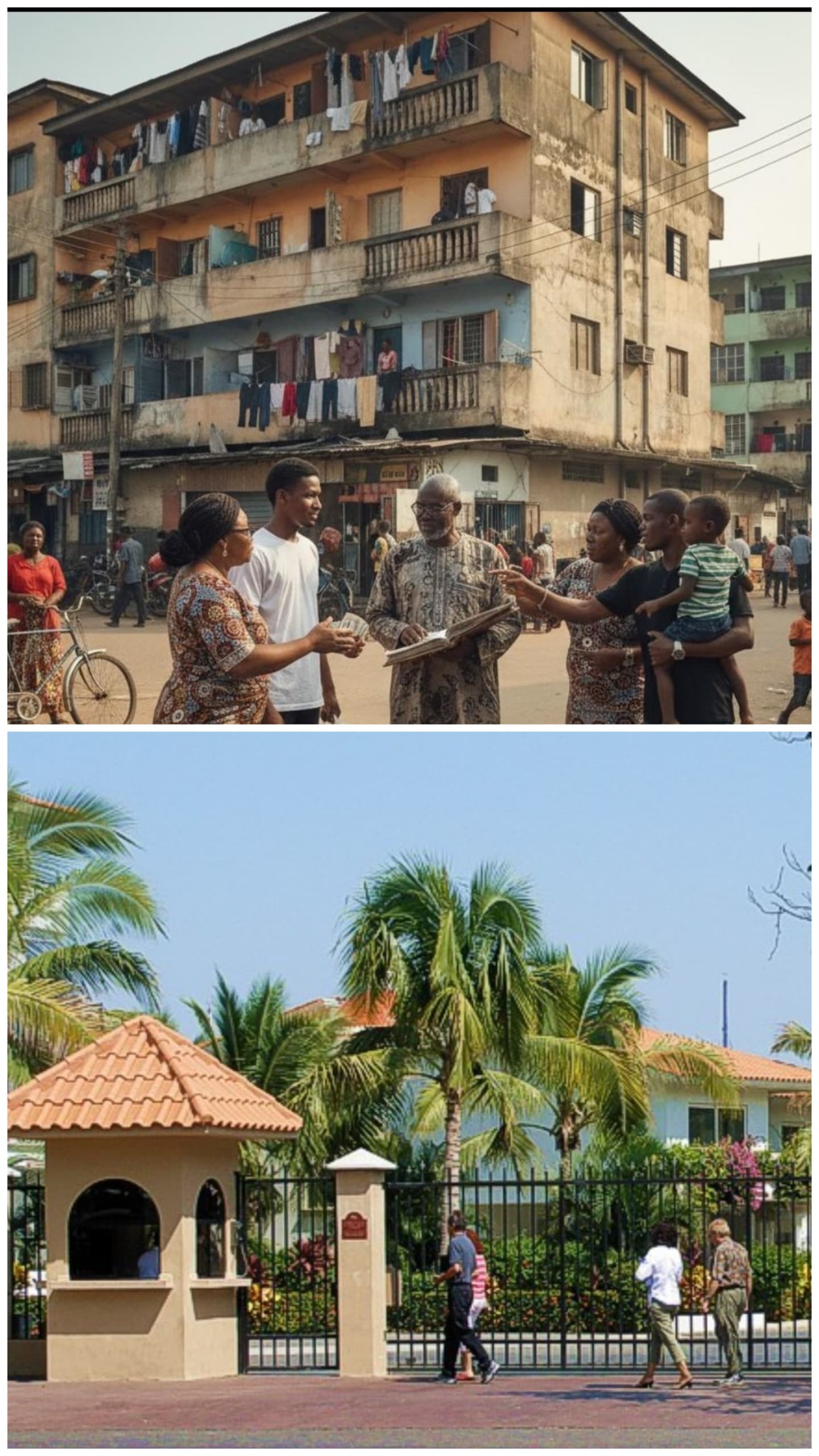
WHEN DID WE STOP KNOWING OUR NEIGHBOURS?
By Priscilla Iyabo Awojuola

There was a time when you did not need an invitation to know your neighbour.
You knew the woman who lived three doors away.
You knew whose child was writing WAEC.
You knew who had just put to bed.
You knew whose husband had travelled.
You knew who was looking for work.
And when someone did not come home at the usual time, somebody noticed.
The neighbourhood was not merely where people lived.
It was a community.
Today, we live closer to one another than ever, yet somehow seem to know less about one another.
We pass each other at the gate.
We nod.
We say, “Good morning.”
Sometimes.
Then we disappear behind our doors.
The neighbour may live five metres away, but his life could be five thousand kilometres from ours.
*THE HOUSE HAS BECOME A FORTRESS*
Walk through many Nigerian cities today, and one thing is difficult to miss.
Walls.
Yes, high walls.
Electric fences.
Security gates.
CCTV cameras.
Guards.
Intercoms.
Some of these measures are understandable. Insecurity has changed the way Nigerians think about their homes and personal safety. Research on Nigerian neighbourhoods has found that fencing and gating are strongly associated with concerns about crime, insecurity, privacy, and control of residential space.
But something else has happened along the way.
The wall that protects us can also separate us.
The gate that keeps danger out can sometimes keep the community out, too.
Recent research on Nigerian gated communities describes a growing form of urban living in which security, privacy, and controlled access are increasingly built into residential life. Scholars have also raised questions about what this means for social integration and cohesion.
We have become safer in some ways.
But are we becoming lonelier?
*WHEN THE COMPOUND WAS A COMMUNITY*
Our parents’ generation had a different experience.
Not perfect.
Not always peaceful.
Certainly not without conflicts.
But there was a stronger sense that somebody else’s problem could become your problem.
A child could wander into the neighbour’s house and be fed.
A neighbour could correct a child.
A woman could borrow a cup of sugar without filling an online form.
When there was a naming ceremony, everyone knew.
When there was a death, everyone came.
When somebody travelled, the neighbour watched the house.
When someone fell sick, people knocked.
Sometimes, the entire compound knew before the family had finished making the announcement.
That was community.
It was inconvenient at times.
It could be intrusive.
People knew too much about one another.
But perhaps that was also its strength.
People knew enough to care.
*NOW WE HAVE WHATSAPP*
Ironically, we may be more connected than any generation before us.
We have WhatsApp groups.
Estate groups.
Street groups.
Residents’ associations.
Facebook communities.
We can send information to hundreds of neighbours without leaving our rooms.
A broken streetlight can be reported in seconds.
A security alert can reach everyone instantly.
A missing child can become known across a neighbourhood within minutes.
Technology has, therefore, not destroyed community.
In some ways, it has given community a new language.
But there is a difference between being connected and being close.
We can know that our neighbour’s generator is disturbing us without knowing that the neighbour has been grieving for weeks.
We can complain about somebody’s parking without knowing that the person is caring for a sick parent.
We can forward a security alert without ever asking the person next door:
“Are you all right?”
*WE ARE AFRAID OF ONE ANOTHER*
Perhaps we should be honest about this.
Trust has become expensive.
We are cautious about strangers.
We are suspicious of visitors.
We hesitate before opening the gate.
We don’t always know who to trust with our children.
And sometimes, we don’t even know who lives beside us.
This caution did not emerge from nowhere.
Nigeria’s urban environment has changed dramatically, and insecurity has influenced how people design and occupy residential spaces. A 2026 study of gated communities in Jos, for instance, found that insecurity and infrastructure deficits were major drivers of gated development while also raising concerns about fragmentation and social integration.
So perhaps the neighbour we no longer know is not necessarily the neighbour we no longer care about.
Perhaps we are also a society that has learned to protect itself.
But protection comes with a price when it becomes complete isolation.
*THE ESTATE GROUP IS NOT THE SAME AS THE STREET*
Something else has changed.
We have replaced the conversation with announcements.
“Water will not flow tomorrow.”
“Security levy is due.”
“Please stop parking here.”
“The gate will close by 10 p.m.”
Everything is official.
Everything is regulated.
Everything is documented.
But when did we last sit outside and simply talk?
Not about service charge.
Not about politics.
Not about the generator.
Not about who has refused to pay his levy.
Just talk.
The 2025 reporting by _THISDAY LIVE_ on gated communities in Nigeria described how residents’ associations and WhatsApp groups are increasingly being used to recreate forms of neighbourhood interaction that once happened face-to-face.
That tells us something important.
Perhaps the community has not disappeared.
Perhaps we are trying to rebuild it in a different form.
*BUT THERE IS HOPE*
Nigeria’s social fabric is not dead.
Far from it.
The 2026 Nigeria Social Cohesion Survey by the Africa Polling Institute recorded a national Social Cohesion Index of 48.8 per cent, an improvement on the previous year. The survey also found continued trust in traditional and religious leaders and evidence of Nigerians’ resilience and commitment to coexistence.
So, the story is not that Nigerians have suddenly become uncaring.
It is that the circumstances in which we practise caring have changed.
The challenge is to ensure that modern living does not make human connection an obsolete tradition.
Because one day, the security guard may know more about our movements than the neighbour next door.
The estate WhatsApp group may know that our water is not flowing.
The CCTV may know when we came home.
The delivery app may know what we ordered for dinner.
But who will know when we are hurting?
Who will notice when we have not been seen for three days?
Who will knock?
*PERHAPS WE SHOULD START AGAIN*
Maybe the community does not require grand gestures.
Maybe it begins with a greeting.
Learning the name of the security guard.
Checking on the elderly woman next door.
Knowing the family living opposite.
Letting children safely play together.
Attending the neighbour’s ceremony.
Offering help when someone is obviously struggling.
Sometimes, it is simply knocking on a door and asking:
“How are you?”
And actually waiting for the answer.
Because perhaps the society we are becoming does not have to be the society we finally become.
We can have our walls.
We can have our gates.
We can have our security systems.
We can have our privacy.
But we must not lose our humanity behind them.
A house can protect the body.
A community protects something deeper.
The feeling that somebody knows you are there.
And perhaps that is what we are slowly losing.
Not our neighbours.
But our willingness to know them.
So, perhaps the question is not really:
When did we stop knowing our neighbours?
Perhaps it is:
When did we stop believing that knowing them mattered?
