


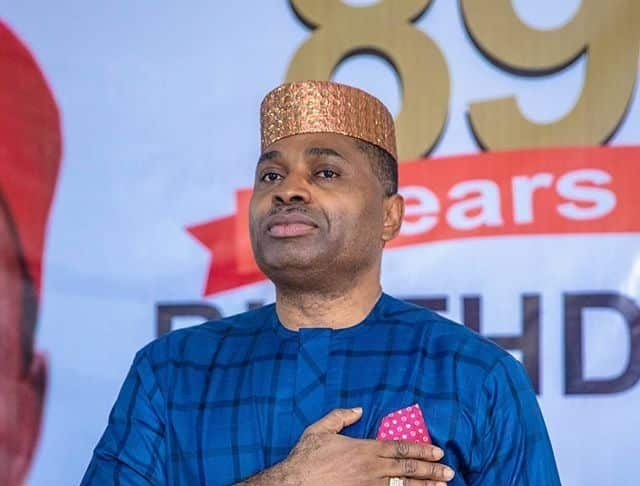
The opposition may struggle to dislodge President Bola Tinubu in 2027 unless rival political forces unite behind a single presidential candidate, former Labour Party chieftain and spokesperson for Atiku Abubakar’s Presidential Campaign, Kenneth Okonkwo, has warned.
Okonkwo said a divided opposition would only fragment votes that could otherwise be consolidated against the ruling All Progressives Congress (APC).

He said this making a strong opposition coalition imperative ahead of the election.
He spoke in an interview with Ibeju Upgrade Media while reacting to the possibility of former Anambra State governor, Peter Obi, challenging Tinubu, including reports of a possible Obi-Rabiu Kwankwaso ticket.
According to him, neither Obi nor any other opposition contender would have sufficient strength to defeat the incumbent without a broader political alliance.
“Coalition is the only way out,” Okonkwo said, stressing the need for opposition parties and political actors to consolidate their support instead of entering the presidential contest separately.
He was particularly dismissive of the prospect of Obi taking on Tinubu without such an arrangement.
“So, if Peter Obi goes against Tinubu alone, Tinubu will eat him like biscuits,” he said.
Okonkwo also questioned whether an Obi-led ticket could make significant gains in Kano State, where Obi contested the 2023 presidential election.
“Will Kano people accept Peter Obi? In 2023, when we had the opportunity, they did not accept him. In 2027, they will not accept him,” he said.
His assessment also extended to Kwankwaso, whose reported partnership with Obi has generated attention in discussions around the emerging opposition alignment.
Okonkwo argued that the former Kano State governor would not add the electoral value being attributed to him, claiming that his political influence had weakened even in Kano.
“Kwankwaso has nothing to contribute to the ticket. Even in Kano, Kwankwaso has lost,” he said.
The remarks come as opposition figures intensify efforts to construct a common platform capable of challenging the APC in the 2027 presidential election.
The search for such an arrangement has, however, been complicated by the ambitions of major opposition figures, with Obi and Atiku previously pursuing separate presidential bids on different platforms.
The G100 Opposition Coalition, led by former APC chieftain Salihu Lukman, has in recent months renewed efforts to persuade opposition parties and political actors to rally around a single candidate against the ruling party.
Okonkwo had previously criticised Obi’s capacity to tackle Nigeria’s economic and developmental challenges.
He has now placed the question of opposition unity at the centre of his argument on the 2027 contest.
The latest intervention also comes against the backdrop of a major realignment of Nigeria’s opposition ahead of the January 2027 presidential election, with the political forces that confronted Tinubu in 2023 now operating on separate platforms.
The 2023 election exposed the cost of that fragmentation.
Tinubu won with more than eight million votes, while Atiku and Obi polled more than six million votes each, leaving the opposition without a single candidate capable of consolidating the anti-APC vote.
In the aftermath, efforts were made to correct that weakness through a coalition that initially brought together major opposition figures and political blocs.
But the arrangement subsequently fractured over leadership, presidential ambition, ticket configuration and the question of who should emerge as the coalition’s presidential standard bearer.
The realignment became more pronounced after Obi and Kwankwaso moved into the Nigeria Democratic Congress (NDC), where they have since emerged as the party’s presidential and vice-presidential ticket.
Their move effectively separated the duo from the opposition arrangement around Atiku and the African Democratic Congress (ADC), creating the possibility of multiple major opposition tickets confronting Tinubu in 2027.
That development has revived the central dilemma facing the opposition and that is whether its leading presidential contenders can subordinate individual ambitions to a single-ticket arrangement capable of pooling their different regional and voter constituencies.
While the NDC is projecting the Obi-Kwankwaso combination as a formidable national ticket, Atiku remains the ADC’s presidential candidate, leaving the opposition with competing claims to the electorate that challenged the APC in the last election.
The ADC has maintained that Atiku does not necessarily require a coalition to defeat Tinubu.
This position underscored the disagreement over whether unity is a prerequisite for victory.
The latest push for a common front is being driven by the G100 Opposition Coalition, which has reopened consultations with opposition leaders and other political actors on the possibility of presenting a single candidate against the APC.
The initiative gained fresh momentum in August, with figures including Atiku, Obi and other opposition politicians involved in renewed discussions on a common platform.
The Peoples Democratic Party (PDP) has also endorsed the G100 process, adding another major political organisation to the renewed attempt to build a broader opposition front.
