


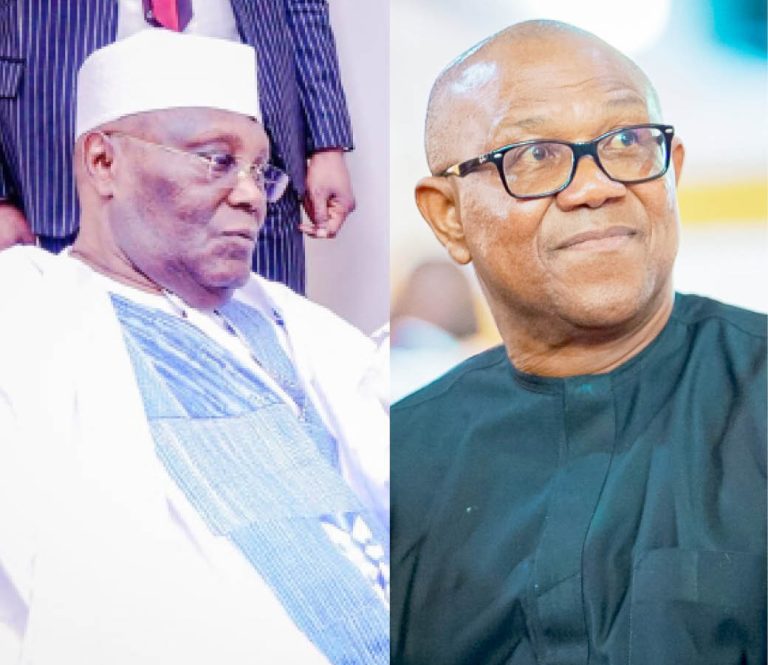
UnUncertainty has continued to trail the proposal for a single opposition presidential candidate ahead of the 2027 general election, with political parties expressing divergent positions on the proposed arrangement.
The development followed a call by the Group of 100 Nigerians led by former All Progressives Congress chieftain, Salisu Lukman, for opposition presidential candidates and political leaders to close ranks and present a common candidate against President Bola Tinubu in 2027.

The group had urged former Vice President Atiku Abubakar of the African Democratic Congress, Peter Obi of the Nigeria Democratic Congress and their respective running mates, Rotimi Amaechi and Rabiu Kwankwaso, as well as other opposition candidates, to subordinate individual interests to the broader objective of defeating the APC-led Federal Government in 2027.
The G-100 argued that a divided opposition, regardless of its numerical strength, would struggle to defeat the ruling party, making a single presidential candidacy necessary to consolidate opposition votes.
Lukman, earlier in the week, announced the convocation of an opposition summit in Abuja on August 18, signalling the group’s determination to advance the proposal and bring the various opposition tendencies to the negotiating table.
However, indications that the proposal may face difficulties have emerged from some of the parties and political movements expected to participate in the process.
In an exclusive interview with The PUNCH, the Senior Special Assistant on Public Communication to ex-Vice President Atiku Abubakar, Mr Phrank Shaibu, came short of confirming his principal’s attendance at the proposed summit, noting that a word to that effect would be made public.
He said, “His Excellency Atiku Abubakar welcomes every genuine initiative aimed at strengthening democratic opposition and providing Nigerians with a credible alternative to the Tinubu administration.
“His attendance at the August 18 summit will, however, be communicated once his schedule and participation are finalised.”
He also lauded the G-100 initiative, saying, “His Excellency has consistently maintained that the challenges confronting Nigeria require opposition parties, leaders and citizens of goodwill to put the national interest above individual or partisan considerations. There is considerable merit in building the broadest possible democratic coalition ahead of 2027.
“What is most important is that any process towards achieving that objective must be transparent, inclusive and democratic, and ultimately produce a candidate capable of earning the confidence of Nigerians.”
On the proposal for a single opposition candidate to confront Tinubu, the ADC candidate was rather evasive, noting, however, that he’s in consultation “with political leaders and stakeholders across the opposition.”
Such engagements, he noted, “are normal and necessary at this stage. The objective is bigger than any individual: to strengthen the opposition, protect our democracy and present Nigerians with a credible alternative to an administration that has failed to meet their expectations.”
He added that “At the appropriate time, the outcome of these consultations will be made public.”
On its part, the Obidient Movement, the support base of the NDC candidate, said an invitation had been extended to Obi to attend the proposed summit but stressed that the decision ultimately rested with him.
The National Coordinator of the movement, Tanko Yunusa, disclosed this in an interview with The PUNCH.
He said, “An invitation has been sent to him. We will see whether he will attend or not. It is left for him to decide on whether to go to such a meeting.”
Yunusa, however, acknowledged the desirability of opposition cooperation, saying, “We agree that it is very good for everyone in the opposition to come together under one umbrella.”
He said he could not confirm whether Atiku had separately contacted Obi over the proposed summit.
The Labour Party, meanwhile, welcomed the principle of opposition collaboration but took a more assertive position, arguing that any coalition seeking to defeat the APC should be built around its existing structure rather than create another political platform.
The party’s National Publicity Secretary, Ken Asogwa, said the Labour Party appreciated “the need for broad-based collaboration among opposition forces to democratically unseat the ruling All Progressives Congress,” but maintained that its platform was already the strongest opposition vehicle for a presidential contest.
According to Asogwa, the party’s connection with the Nigeria Labour Congress and the Trade Union Congress gives it an organisational advantage that other political parties cannot easily replicate.
He told our correspondent, “The Labour Party is unique among all political parties because the NLC and the TUC are its institutional members,” he said.
He added that the connection gives the party access to a nationwide network of serving and retired civil servants.
“By implication, every serving and retired civil servant across the country is naturally connected to the LP family through these labour institutions,” Asogwa said.
The LP spokesman argued that the structure extended from the national level to polling units, wards, local government areas and communities, describing it as an advantage that should not be discarded in the search for a coalition arrangement.
He, therefore, called on political groups and individuals seeking to form a formidable opposition alliance to instead strengthen the LP.
“It is against this backdrop that the Labour Party respectfully calls on all individuals, groups and political movements seeking to build a formidable opposition coalition to collapse their structures into the Labour Party,” he said.
Asogwa also argued that the party already had what he described as an “energised membership base” and a credible presidential candidate capable of offering Nigerians an alternative to the APC.
“The task before the opposition is not to reinvent the wheel but to unite behind the most viable platform. That platform is the Labour Party,” he said.
The Democratic Leadership Alliance, on the other hand, adopted a more cautious position, welcoming the idea of opposition cooperation but distancing itself from any immediate commitment to a single-candidate arrangement.
The party’s Deputy National Publicity Secretary, Judith Aguenu, said the DLA appreciated the call for opposition forces to work together but disclosed that the party was not currently negotiating with the group or any political party on the adoption of a common presidential candidate.
“The Democratic Leadership Alliance appreciates the call by the G-100 and other stakeholders for opposition forces to close ranks ahead of the 2027 general elections.
“However, at this stage, the DLA is not in talks with the G-100 or any other political party or group regarding the adoption or nomination of a single presidential candidate,” Aguenu said.
According to her, the immediate priority of the DLA was to strengthen its own platform and position it as a credible alternative ahead of the election.
Aguenu, however, said the party remained open to engagement with opposition parties, political movements and civil society organisations sharing its commitment to accountable and people-oriented governance.
“For us, the conversation should go beyond merely producing a single candidate. It must be about building a credible political platform, agreeing on a clear vision for Nigeria, and presenting Nigerians with a leadership alternative they can trust,” she said.
In a separate interview with The PUNCH, the Coalition of United Political Parties commended Lukman and his colleagues for the initiative and pledged its commitment to the success of the summit.
Speaking with our correspondent, the spokesperson of CUPP, Agu Bryan, said the summit would help unite the opposition as a single force ahead of next year’s general election.
“The CUPP acknowledges and appreciates the initiative of the G-100 in convening an opposition summit aimed at fostering greater unity and strategic cooperation among opposition political forces ahead of the 2027 general elections.
“We commend their personal sacrifices, commitment to democratic consolidation and stake in the quest for accountable and good governance in Nigeria.
“CUPP has consistently advocated, from its inception, for the possibility of a single, formidable opposition presidential candidate where practicable.
“We believe that a united opposition, anchored on a credible candidacy and a coherent alternative policy platform, stands a stronger chance of providing Nigerians with a viable democratic alternative to the Tinubu-led administration.
“Accordingly, CUPP is prepared to support and work for the success of a consensus opposition candidate, should the major opposition contenders, including Peter Obi, Atiku Abubakar and others, arrive at a mutually acceptable arrangement in the overriding national interest,” he said.
That said, Bryan underscored the importance of free and credible polls.
“Opposition unity must go hand-in-hand with a sustained demand for free, fair, transparent and credible elections. A credible electoral process is the foundation of legitimate governance and the essential pathway to ensuring that the will of Nigerian voters is freely expressed and respected.
“CUPP, therefore, welcomes the August 18 Abuja opposition summit with an open mind and is willing to engage with every credible initiative capable of building a more formidable, united and democratic opposition ahead of 2027,” he added.
While the G-100 believes that a common presidential candidate is essential to prevent the opposition vote from being divided, some political actors appear unwilling to surrender their existing platforms without a clear agreement on the structure, leadership and principles of any proposed coalition.
The issue of presidential candidacy is expected to be particularly contentious given the calibre of opposition figures already positioning themselves for the 2027 contest.
Atiku, Obi and Kwankwaso command distinct political constituencies, while the Labour Party and other emerging opposition platforms are seeking to consolidate their own structures ahead of the election.
The proposed August 18 summit may provide an early test of whether the various opposition tendencies can move beyond individual party interests and agree on a common political strategy.
For the G-100, the argument remains that only a united opposition can mount a serious challenge to the APC and prevent another fragmentation of votes.
For the parties involved, however, the emerging responses suggest that agreeing on who should lead such a coalition may prove considerably more difficult than agreeing on the need for opposition cooperation.
With the 2027 election still months away, opposition leaders have time to negotiate, but the divergent positions already emerging indicate that the road to a single presidential candidacy is unlikely to be straightforward.
(Punch)
