


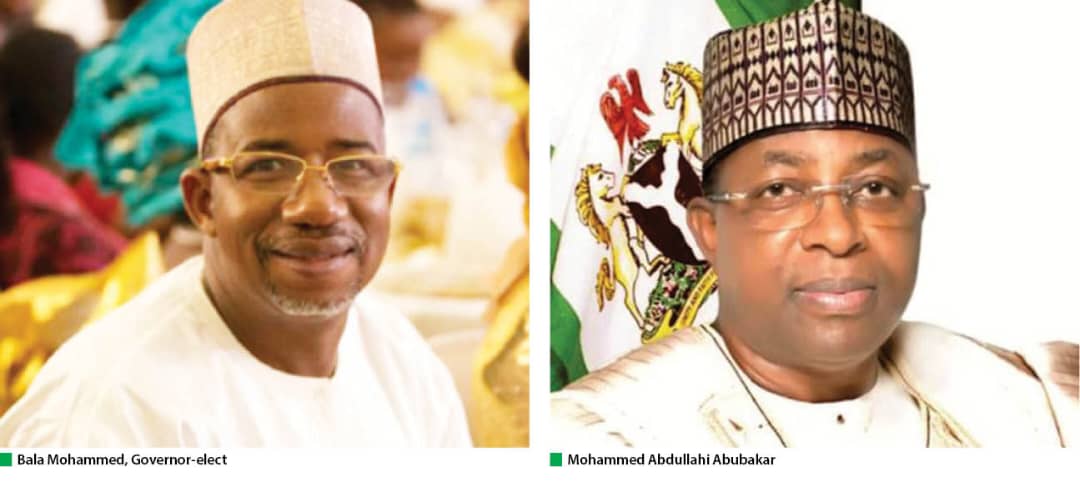
By Umar Ibrahim Sade
The publication by Daure David, presented as a “data-driven” account of the Mohammed Abdullahi Abubakar SAN administration, deserves a more thorough examination because it relies heavily on the 2020 Assets and Funds Recovery Committee report while presenting several allegations and recommendations as though they constitute final judicial findings. That distinction is fundamental to professional journalism. The committee was constituted by the administration of Senator Bala Abdulkadir Mohammed in 2019 to investigate alleged diversion of assets and funds between 2007 and 2019, and its chairman reported findings concerning the two preceding administrations.

However, the committee report is not a court judgment, and allegations contained in such a report cannot automatically be converted into established criminal facts. Indeed, the former governor’s representatives publicly rejected the allegations at the time. The first question Daure David should therefore answer is simple: when the document he is relying upon contains allegations, recommendations and disputed findings, by what journalistic principle does he transform every allegation into an established fact while giving comparatively little attention to the responses of the persons accused?
The figures themselves also demand context rather than sensational presentation. The committee reported that the two administrations under review received more than ₦1 trillion in statutory allocations, alongside more than ₦65 billion in special releases to the immediate past administration, and it cited 12,249 contracts and services submitted by 19 MDAs with a combined value of ₦97.19 billion. It also reported 16 plots in Kaduna valued at about ₦1.5 billion, a Kano property valued at ₦284.349 million, and the recovery of 23 vehicles and four tractors. Those are figures worth reporting, but they do not, by themselves, establish that the former governor personally stole the amounts cited or that every contract examined represented wrongdoing.
The unanswered question is, Where is the distinction between money received by a government, money appropriated, money spent on government obligations, money allegedly misapplied, and money personally diverted? A professional journalist must establish those distinctions. Similarly, the N97.19 billion contract figure cannot reasonably be presented as N97.19 billion of corruption because the committee itself said only 78 contracts valued at N63.84 billion had been verified and analysed. The question therefore becomes: how many of those 78 contracts were ultimately found unlawful by a competent court, how much money was actually established to have been diverted, and what was the final legal outcome? Without answers, the numbers remain an account of an investigation—not a conviction.
There is another essential part of the 2015–2019 story that the publication substantially underplays: the economic circumstances in which M. A. Abubakar governed Bauchi State. Nigeria entered recession in 2016 following a severe oil-price and foreign-exchange shock, while states were simultaneously struggling with salary obligations, debt and falling revenues. Contemporary accounts record that Abubakar said he inherited an empty treasury, four months of unpaid salaries, about ₦15 billion in outstanding gratuities and a debt burden he variously put at approximately ₦120–₦155 billion.
He also stated that the state’s wage bill was about ₦5.1 billion monthly while federal allocations frequently fell below that level. Whether every component of those inherited liabilities should be accepted without audit is itself a matter for documentary verification, but the economic pressure cannot honestly be removed from the historical record. It is also important not to repeat the claim that Nigeria experienced “two recessions” during the 2015–2019 tenure as a precise fact: the nationally recognised recession within that tenure was the 2016 recession; the COVID-19 recession occurred in 2020, after Abubakar had left office. What can legitimately be said is that his tenure operated amid severe economic shocks and fiscal constraints. Despite that environment, contemporary reporting documented projects and interventions including primary healthcare facilities, agriculture programmes, education spending and the revival of the Bauchi fertiliser plant.
Then comes perhaps the most important question in this entire debate: if Daure David regards Senator Bala Abdulkadir Mohammed CON as his principal, whose assessment should carry greater evidentiary weight, the political commentary of Daure David or the public words of the man he claims to represent? Governor Bala is not merely a commentator on M. A. Abubakar; he is the politician who contested against him in 2019, succeeded him as Governor of Bauchi State and subsequently had access to the institutions, records and administrative machinery of the state.
Yet, at the state dinner organised in honour of M. A. Abubakar following his elevation to Senior Advocate of Nigeria, Governor Bala publicly described his predecessor as his “elder brother” and said that Abubakar had “shown what leadership should be” and had gone beyond his expectations and those of many politicians. More significantly, the event was organised by Governor Bala’s own administration. If Daure David’s portrayal is that of M. A. Abubakar’s tenure can principally be defined through allegations of diversion and administrative wrongdoing, how does he reconcile that portrayal with the incumbent governor’s own public decision to honour the former governor and describe his leadership in such positive terms? That contradiction deserves an answer, not avoidance.
The financial narrative equally requires intellectual honesty. In 2019, there was a public dispute over approximately ₦11.6 billion reportedly remaining in Bauchi’s government accounts at the transition. The Bala administration’s spokesman disputed the former administration’s account and alleged that the money was at risk of being paid out, while the former administration maintained its own explanation. There was also a separate controversy over ₦8.5 billion paid to contractors shortly before handover.
In a court filing, M. A. Abubakar explained that the payment was related to work undertaken by Bauchi State for the Federal Government and that the state had received a federal refund shortly before the handover. He said the state had executed federal infrastructure works worth approximately ₦14.6 billion and that part of the refund was subsequently paid to contractors. Again, the professional question is not simply, “Was ₦8.5 billion paid?” The answer is documented. The proper questions are: Where did the money originate? What work generated the refund? What contracts were paid? What approvals existed? What did the court ultimately determine? This is what separates investigative journalism from political content creation.
Finally, the attempt to define M. A. Abubakar SAN exclusively through the recovery committee’s allegations ignores the broader public record and the need to allow competing evidence to speak. Daure David is entitled to his political interpretation, but his interpretation should not be confused with an authoritative historical verdict. The records contain allegations by the Bala administration, rebuttals by the Abubakar administration, financial data from independent institutions, contemporary reports of projects and fiscal challenges, and most significantly the later public assessment of M. A. Abubakar by Governor Bala himself.
So who is more reliable in defining M. A. Abubakar: a social-media commentator whose intervention is necessarily political, or the incumbent governor who actually succeeded him, governed with access to the state’s records, contested him politically and nevertheless publicly acknowledged his leadership? That question should be left before the people of Bauchi with the evidence on both sides. The responsible conclusion is not to erase the recovery committee’s allegations, nor to erase M. A. Abubakar’s responses and record, but to demand evidence, distinguish allegations from proven facts, and allow the complete documentary record to speak. That is the standard expected of journalism and it is precisely why political commentary should never be allowed to replace professional scrutiny.
The credibility of the platform itself must also be put to the test, because Kaura Independent Communication has increasingly operated more as an attention-seeking social-media handle than as a professionally grounded journalistic platform, with publications that often rely on sensational claims, selective presentation of information and narratives that require independent verification before they can reasonably be treated as established facts.
Its content should therefore be subjected to the same basic standards expected of responsible journalism: verification, balance, attribution, documentary evidence and the opportunity for affected persons to respond. In matters as serious as public finances, alleged misconduct and the reputations of former public officials, attention should never be mistaken for credibility, and virality should never substitute for facts that can withstand scrutiny.
