


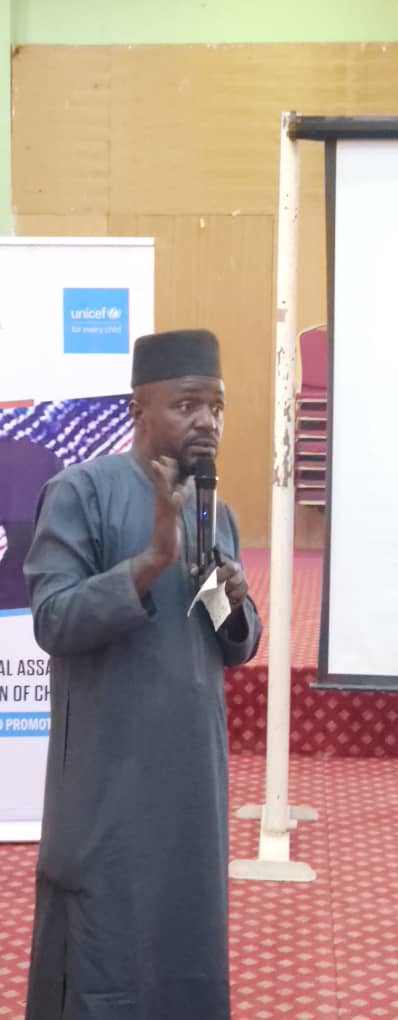
From Khalid Idris Doya, Bauchi
A security expert and lecturer at Abubakar Tatari Ali Polytechnic, Bauchi, Comrade Abdullahi Yalwa, has stated that while Nigeria possesses a strong legal framework for child protection compared to some countries, poor implementation remains a major obstacle.
Yalwa stressed that addressing the gap requires a coordinated approach involving legal reforms, institutional strengthening, and alignment with socio-cultural realities.
He made this known while presenting a paper titled “Legal Frameworks and Protection Systems in Nigeria: An Overview of Child Protection Laws with Focus on Northern States” at a one-day stakeholders’ roundtable and media advocacy on child rights organised by the UNICEF Bauchi Field Office held in Gombe yesterday.
According to him, Nigeria’s child protection system represents a complex blend of international standards and local realities. However, he noted that its effectiveness is increasingly undermined by the disconnect between statutory provisions and regional socio-cultural dynamics.
Dr. Yalwa, a former Head of Department of Crime Management and Control at the ATAP, observed that in Northern Nigeria, child protection is weakened by a combination of structural deficiencies, legal pluralism, and entrenched socio-cultural practices.
He explained that Nigeria is a signatory to several key international instruments, including the United Nations Convention on the Rights of the Child (CRC), the African Charter on the Rights and Welfare of the Child (ACRWC), and International Labour Organization conventions on child labour.
“These instruments mandate Nigeria to guarantee children’s rights to survival, development, protection, and participation,” he said.
On the domestic front, he listed key legislations such as the Child Rights Act (2003), Violence Against Persons (Prohibition) Act (2015), Trafficking in Persons Act (2015), and the Universal Basic Education Act (2004) as pillars of the country’s child protection framework.
Dr. Yalwa further highlighted core legal principles underpinning these laws, including the best interest of the child, the right to survival and development, non-discrimination, and child participation rights.
Despite these provisions, he noted that Nigeria’s federal structure requires individual states to domesticate child protection laws, resulting in uneven enforcement, particularly in Northern states where adoption has been delayed or modified.
He also pointed to legal pluralism in the region, where statutory, customary, and Sharia laws coexist, often leading to conflicts in areas such as child marriage, guardianship, and disciplinary practices.
The expert identified key institutions responsible for child protection, including Ministries of Women Affairs, Family Courts, NAPTIP, police units, and social welfare services.
However, he said these institutions are hampered by underfunding, shortage of trained personnel, weak enforcement mechanisms, and poor inter-agency coordination.
Yalwa further noted that socio-cultural factors, such as the influence of tradition and religion, low awareness of child rights, and reliance on informal justice systems, continue to hinder effective protection.
He added that socio-economic challenges, including poverty, low literacy rates, gender inequality, and the Almajiri system, further exacerbate the vulnerability of children.
Highlighting emerging threats, he listed child trafficking, migration, street children, digital exploitation, and conflict-related abuses in Northern Nigeria as growing concerns.
Yalwa expressed worry over persistent enforcement gaps, including low reporting rates, weak accountability structures, limited access to justice in rural areas, and overdependence on non-governmental organisations.
Comparatively, he noted that although Nigeria’s legal framework is strong, countries with more centralised child protection systems tend to achieve better outcomes.
He called for the full domestication of the Child Rights Act across all states, increased funding, strengthened institutions, and sustained public awareness campaigns.
Yalwa also advocated for deeper community engagement involving traditional leaders, alongside education initiatives, poverty alleviation programmes, and reform of the Almajiri system to ensure lasting protection of children’s rights.
